
Marketers are in full panic mode over declining website traffic. But they are mourning the wrong thing.
For 20 years, we built a collective muscle memory based on a flawed premise: intercept people with tactical tricks, lure them to our websites, and trap them behind lead forms in exchange for our “expertise.” We optimized for keywords instead of distinct points of view. In the name of measurable performance, we watered down our messaging until our websites became a sea of sameness—vanilla blobs completely indistinguishable from our competitors, except for some different color paint.
Now, the digital ecosystem has shifted, and that 20-year muscle memory is actively working against us.
AI discovery platforms—Google AI Overviews, ChatGPT, Claude, Perplexity—are the new gatekeepers between your brand and your buyers. And here is the harsh reality: You cannot trick a Large Language Model with generic SEO (or GEO) fluff. You have to train it. If you want AI to recommend your brand, you have to stop hiding your secret sauce behind gates and start educating the market with original data, lived subject-matter expert (SME) experience, and the challenger swagger that proves you see the world differently than everyone else.
If your dashboard still leads with traffic, rankings, and MQLs, it’s measuring a shrinking, later-visible slice of a buying journey that increasingly happens somewhere you can’t see it. That’s not a reason to panic about declining traffic. It’s a reason to change what you measure.
The Authority Illusion (And How We Built It Before AI)
When a brand gets into business, it’s because they see an opportunity to serve an unmet need. But instead of shouting that unique value from the rooftops, marketers bottled it up to focus on the top of the funnel.
In the early days of Skyword, we took a different approach. We helped Colgate build global authority by launching the Oral Care Center, designed simply to help young families understand oral hygiene. We helped a division of IBM build Security Intelligence to teach IT professionals how to keep their data safe. We did the same with NAPA’s Know-How blog.
Yes, we drove millions of site visits, and we measured time on site, lead gen, and conversion rates. But those were just the proxy metrics of the era. What we were actually doing was establishing undisputed category authority in the digital ecosystem of the day. Colgate owned “Oral Care.” IBM owned “Information Security.” NAPA owned “Auto Maintenance.” That authority is what grew awareness, preference, and ultimately, revenue.
Today, the goal—building category authority—remains exactly the same. But the gatekeeper has changed.
The Blind Spot in Traditional Content Measurement
Buyers increasingly get answers directly from AI assistants without ever visiting a website. As more research happens inside private platforms and AI chats, marketers lose visibility, and traditional metrics become less representative of how buyers actually decide.
Consider the data:
94%
of B2B decision-makers used an LLM in their purchase process in 2025
81%
of buyers choose a vendor before ever contacting sales
68%
of U.S. Google searches ended without a click
47%
of consumers have taken a real action based on AI-generated brand information
Forrester, B2B Buyers Make Zero-Click Buying Number One, 2025; 6sense, 2024 Buyer Experience Report; SparkToro, In 2026, Less than One Third of Google Searches Still Send a Click, June 8, 2026; Skyword, AI Is Already Shaping How Your Buyers Decide, a survey conducted by Skyword and fielded by Dynata in April 2026 among 1,000 U.S. adults aged 18 and older, 2026.
For two decades, enterprise marketing measured content primarily as a traffic-acquisition tool. That made sense when company websites were the primary place buyers learned. Today, buyers learn everywhere: they ask AI, consult peers, read analyst reports, listen to creators, and compare reviews before ever visiting a company’s website to validate and transact.
Your website can persuade someone who visits it. It can’t persuade someone who never had a reason to visit.
A brand’s competitive advantage today isn’t the ability to rank in search and generate clicks. It’s the authority it carries among buyers and the AI systems, analysts, journalists, and peers they rely on when making purchase decisions. We call this category authority: the degree to which a brand is recognized as a trusted source on the topics that influence purchasing decisions in its category.
Why Traditional Content Marketing Metrics Are Losing Reliability
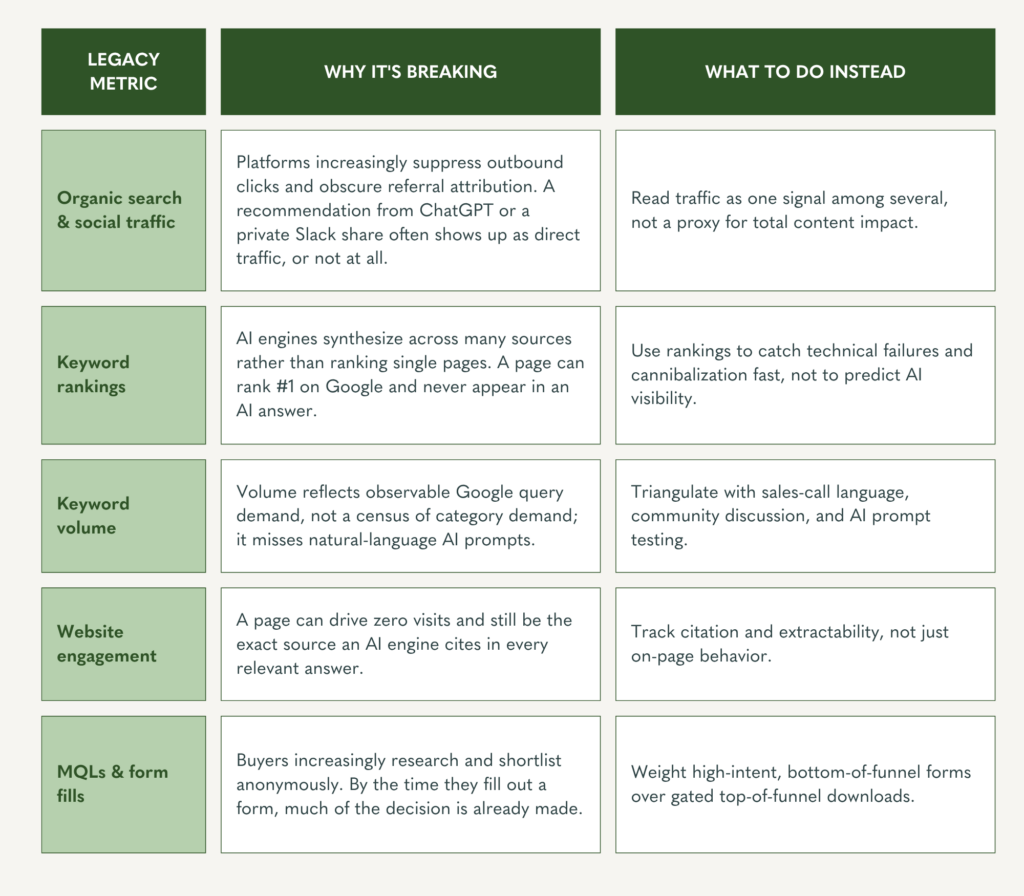
Traditional content metrics—traffic, rankings, keyword volume, engagement, and MQLs—are losing reliability as measures of content marketing ROI because they only capture activity that happens on your owned properties, while an increasing share of the buying journey happens off-site and inside AI-generated answers.
Ahrefs found only 38% of AI Overview citations came from top-10 ranking pages, with 31% coming from pages ranking beyond position 100. (Source: Ahrefs, Update: 38% of AI Overview Citations Pull From Top 10 Pages, March 2026). For standalone AI assistants, Ahrefs found that roughly 12% of citations rank in Google’s top 10, and about 80% don’t rank anywhere for the query the user actually typed. (Source: Ahrefs, Only 12% of AI Cited URLs Rank in Google’s Top 10 for the Original Prompt, May 2026).
None of the legacy metrics are worthless. They’re just answering a narrower question than they used to:
Why AI Visibility Dashboards Aren’t a Content Marketing ROI Solution
AI visibility dashboards measure sampled, simulated prompts, not real buyer behavior, and their scores are too unstable across models, locations, and time to serve as a standalone ROI metric.
It’s tempting to simply swap one metric for another: AI is absorbing search traffic, so start tracking AI visibility instead. Two major problems get in the way:
- AI visibility scores aren’t based on observable behavior: they’re sampled from a defined set of simulated prompts, and there’s no way to know how closely that panel resembles real buyer questions.
- AI answers vary: by model, prompt, location, and timing, so no single score is stable.
Meaningful measurement doesn’t come from replacing traffic metrics with AI visibility metrics. It comes from an array of leading indicators that collectively predict whether a brand gets discovered, trusted, referenced, and recommended, followed by metrics that measure the downstream impact on the business.
Why Category Authority Predicts Content Marketing ROI Better Than Traffic Volume
Brands used to compete on search visibility. Now they compete on category authority.
I recently spoke with a marketing executive at a global consumer company that had just optimized its sites for search. The team used AI to scale asset creation. When we ran unbranded category prompts through LLMs, the brand did not even appear, but its competitors did.
Even with its high content volume, the brand’s messaging did not create enough differentiated signals to earn LLM trust, and the brand lost control of its own narrative and was already experiencing the downstream impact on the business.
The problem wasn’t that the brand didn’t have differentiated content—they did. The problem was that it was gated and therefore hidden from AI engines, so the brand appeared to have generalist expertise, versus distinct expertise.
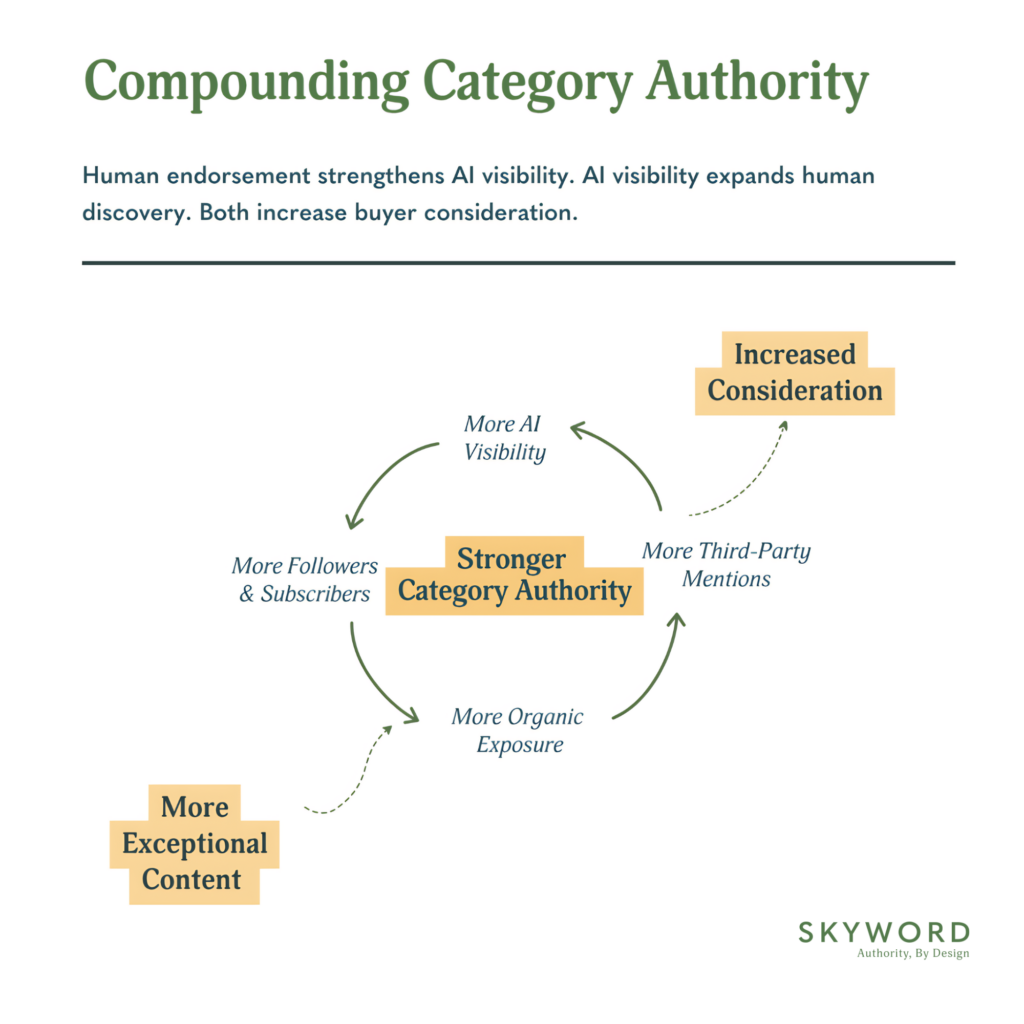
The more useful the content, the more others share it, the more experts reference it, the more publishers cite it, and the more AI engines recommend it. That’s a flywheel, and it’s the mechanism measurement needs to track:
A brand contributes something useful:
original research, evidence, or a distinctive point of view
The market validates it:
customers, analysts, and creators reference or endorse it
AI systems take notice:
and absorb it into the evidence they retrieve on the topic
AI systems surface it to more buyers:
in answers and private chats
The next cycle starts from a stronger position:
human recognition strengthens AI visibility, and AI visibility expands human discovery
At a high level, content marketing metrics should help answer three questions: Are we creating content that’s trusted, shared, and recommended? Are buyers and AI recognizing us as an authority on the topics that matter most? Is that authority creating measurable business value?
The New Measurement Framework: Readiness, Influence, Impact
Meaningful measurement doesn’t come from replacing traffic metrics with generic “AI visibility metrics” (which are often sampled from simulated prompts and highly unstable). It comes from an array of leading indicators that collectively predict whether a brand gets discovered, trusted, referenced, and recommended, followed by metrics that measure the downstream impact on the business.
Rather than replacing one KPI set with another, the goal is to measure the stages that connect content investment to business outcomes.
Skyword’s Three-Stage Measurement Framework
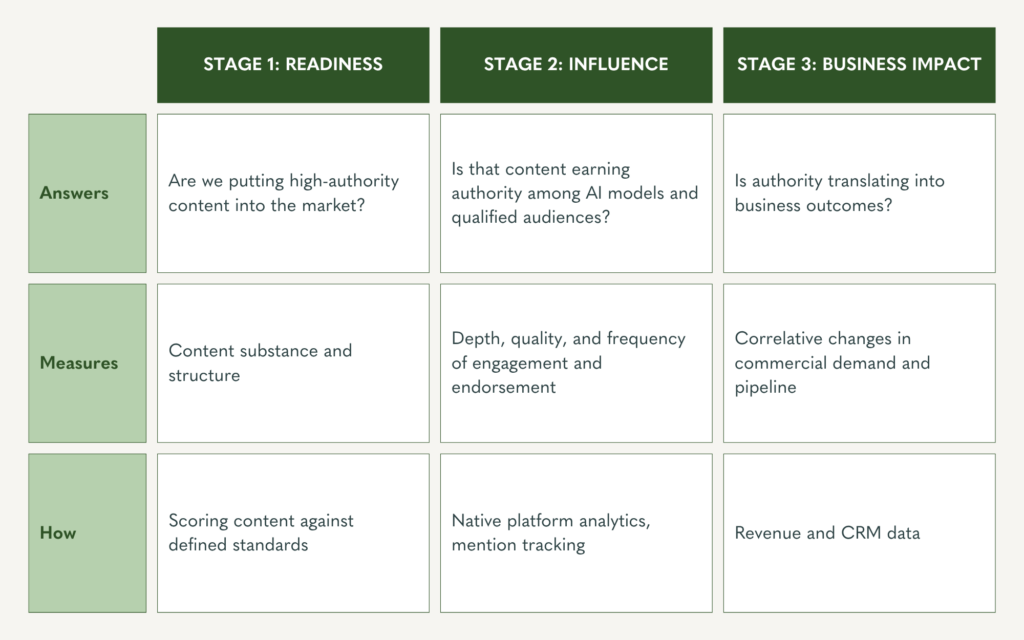
Readiness Signals
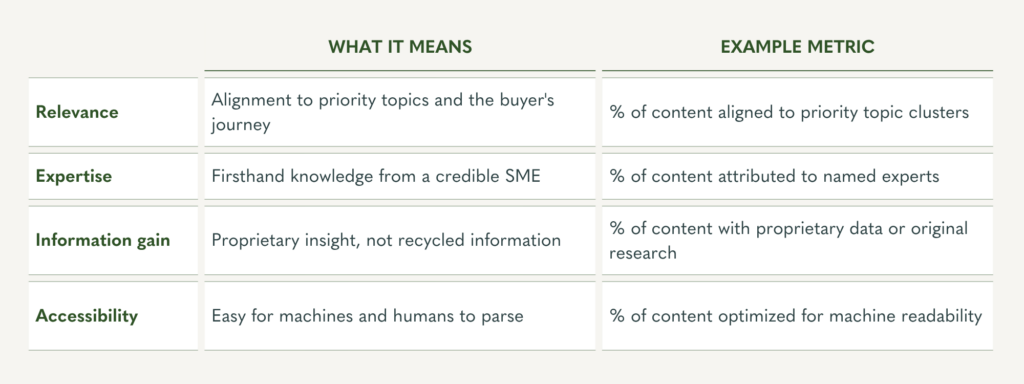
Influence & Business Impact Signals
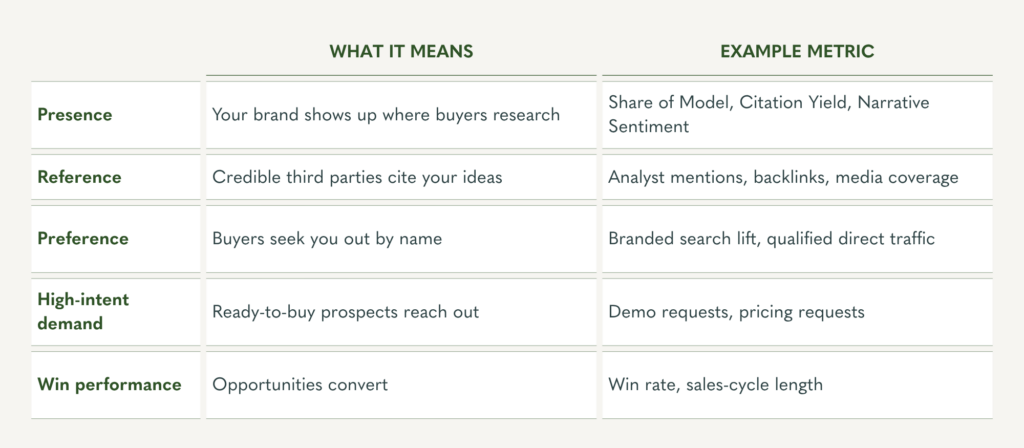
How Skyword Operationalizes Category Authority
To move this from theory to practice, Skyword utilizes two proprietary diagnostics:
Category Authority Index™ (CAI)—A domain-level readiness score (0–100) that predicts visibility breakthroughs and competitive exposure before they show up in business results.
Category Authority Standard™ (CAS)—An asset-level standard ensuring every piece of content has both substance (original insight) and structure (schema, direct answers) that make it referenceable.
Operationalize Category Authority in 5 Steps
Assess readiness
The CAI evaluates the domain; the CAS audits individual assets against authority-building standards.
Build readiness
Apply the CAS to new and existing content to ensure that it earns discovery.
Measure signals
Track Share of Model, Citation Yield, third-party citations, and top-level domain traffic.
Prove impact
Connect authority growth to higher-intent conversions, shorter sales cycles, and stronger win rates.
Audit maturity
Recheck the CAI quarterly; keep asset-level accountability always-on via the CAS.
CAI in Practice: What the Scores Actually Reveal
To make the CAI concrete, consider a preliminary audit run on Coca-Cola—not a Skyword client, but a brand recognizable enough that the pattern speaks for itself. This audit assumes Coca-Cola wants to reach health-conscious Gen Z consumers who may be more apt to do research around the products they consume. The composite score landed at 42 out of 100, squarely in the “Average” band, with an archetype we call “The Empty Suit”: a brand AI engines mention constantly but almost never cite as a source.
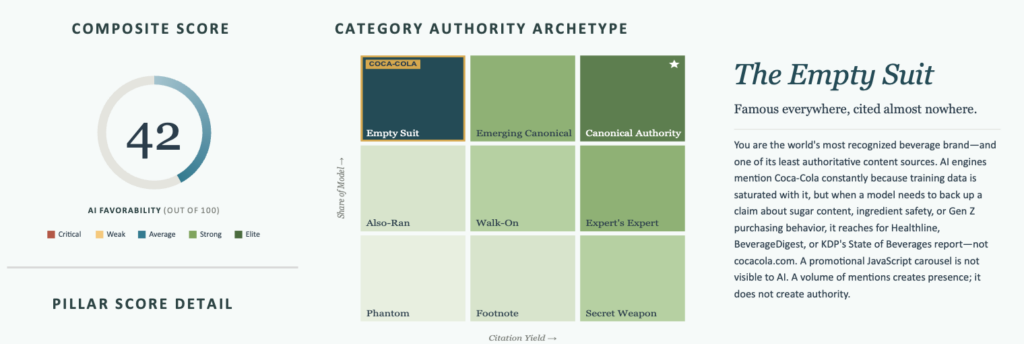
Coca-Cola’s Share of Model (how often AI brings the brand up at all) scored a respectable 24 out of 40, reflecting decades of brand saturation in training data. But its Citation Yield, how often AI actually links back to Coca-Cola’s own content as evidence, scored just 4 out of 30. When AI models needed to back up a claim about sugar content or ingredient safety, they reached for Healthline or a competitor’s sustainability report instead of cocacola.com.
The gap is the finding: near-universal recognition doesn’t guarantee authority, and a brand can be famous everywhere while being functionally invisible as a source. That disconnect, between assumed authority and what a CAI audit actually reveals, is exactly the kind of gap the score is built to surface.
Metrics in Action: Building Your Content ROI Scorecards
The same framework needs to flex for two audiences: a board that wants defensible numbers, and a marketing leadership team that needs enough detail to optimize strategy.
The Board-Level Scorecard
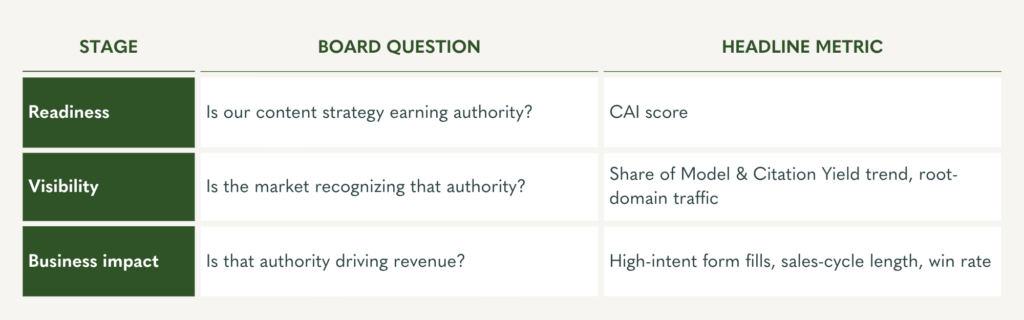
Reframing the Board Conversation
Instead of saying: | Say this: |
“Traffic doesn’t matter anymore.” | “Traffic still matters, but it’s a smaller, later-visible share of buyer research.” |
“AI citations are our new ROI metric.” | “AI citations are a leading indicator of trust; revenue remains the proof of value.” |
“We can’t attribute anything anymore.” | “Perfect attribution never existed—we’re triangulating behavior, influence, and outcomes.” |
“Our content drove the deal.” | “The account was exposed to our content; CRM and sales data validate the contribution.” |
A tip for skeptical executives:
Don’t explain the theory—show it. Ask an AI assistant a realistic buyer question in your category, live, in front of leadership. Watching your own brand get left out of a live AI answer changes minds faster than any slide of definitions. Especially when it is perceived to be your strongest offering.
The first step is understanding where your brand already has authority, where it’s being overlooked, where competitors are shaping the answer instead, and at what cost to you.
The New Marketing Leadership Scorecard
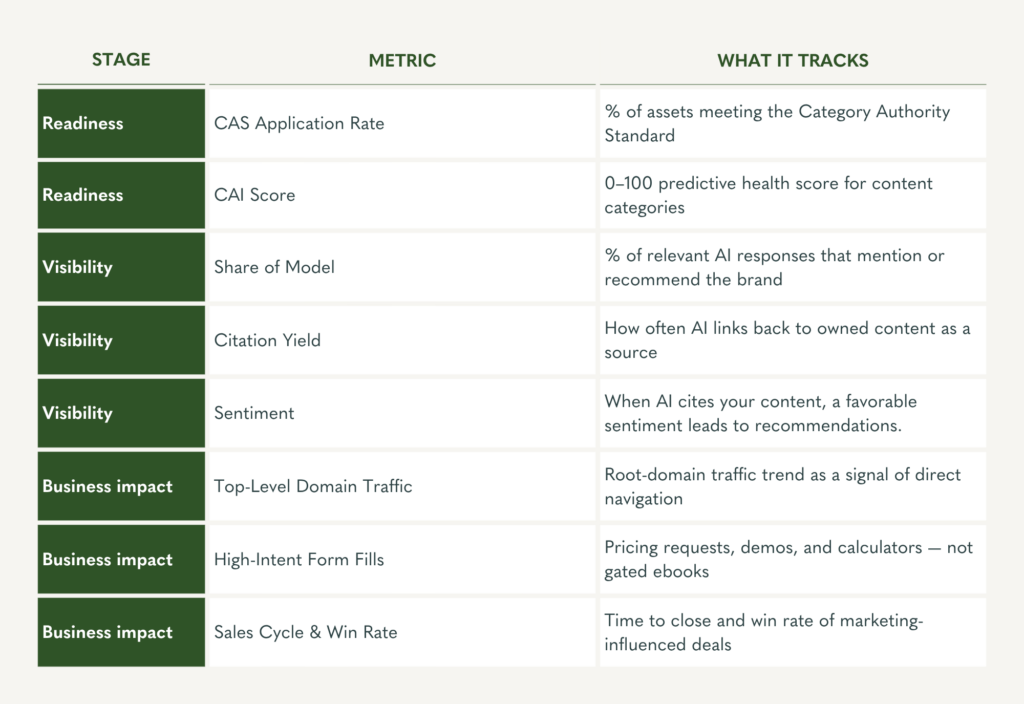
This scorecard runs alongside your existing SEO, traffic, and funnel reporting from day one. It’s additive, not a replacement.
“We’re not removing traffic from reporting—we’re being more precise about a specific type of traffic and what it actually measures. Top-level domain traffic captures the portion of buyer research that reaches our website during the buying process; it no longer captures the full market influence our content creates.”
Christina Mautz
Chief Marketing Officer, Skyword
The Biggest Measurement Traps to Avoid
- Creating 1:1 replacement metrics. Renaming MQLs to AQLs doesn’t fix anything if the new metric still only measures owned-property activity.
- Treating AI metrics as proof of revenue. Share of Model, Citation Yield, and Sentiment are leading indicators, not measurements of business impact.
- Updating the dashboard without upgrading the content. You can’t earn recommendations without distinct expertise, no matter how many metrics you add to the report.
- Optimizing for algorithms instead of buyers. Schema without distinct expertise produces unstable visibility because AI is getting better at spotting structural mimicry.
- Abandoning legacy metrics entirely. Traffic as a metric needs to be viewed differently. It hasn’t become worthless.
How to Transition Without Losing Executive Confidence
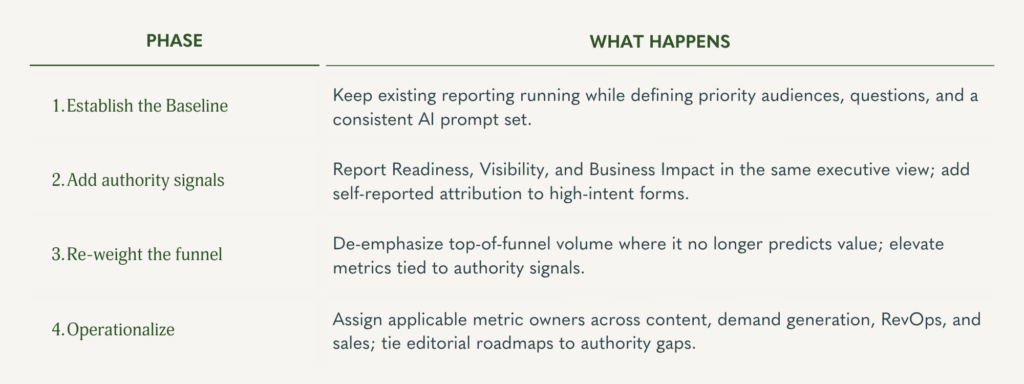
Most organizations see a pattern: new metrics run in parallel from day one; by 3–6 months, Share of Model and Citation Yield show clear trends; by 6–9 months, if the scorecard correlates with real outcomes, it becomes the primary report.
AI search is changing how buyers learn, compare, and decide. You create much less content, but it’s much more strategic. And because AI engines synthesize new information constantly, you don’t have to wait months for an SEO algorithm to index you. You see results in days and weeks.
The first step is understanding where your brand already has authority, where it’s being overlooked, where competitors are shaping the answer instead, and at what cost to you.
Data cited above draws on Forrester (2025, 2026), 6sense (2024, 2026), SparkToro (2026), Ahrefs (March 2026, May 2026), and Skyword’s proprietary consumer research (2026).
Frequently Asked Questions
Should enterprise marketers stop tracking MQLs?
No. MQLs remain useful as an operational funnel metric. However, they shouldn’t be treated as the sole measure of content value, since they capture known contacts, not the buyers still researching anonymously.
How does Share of Model differ from Share of Voice?
Share of Voice measures relative visibility in media, social, or search. Share of Model measures how often a brand appears in AI-generated responses for relevant buyer questions.
What are the limits of AI-visibility measurement today?
AI answers are personalized, so the same question can return different results depending on user context and history. Until that black box opens, treat AI visibility scores as directional, and triangulate them with branded search lift, direct-traffic segmentation, and self-reported attribution on high-intent forms.
What is Citation Yield?
The rate at which AI-generated responses cite or link to a brand’s owned content as a source. It measures source trust and content extractability, distinct from Share of Model.
How long does the transition take?
It typically takes 6–9 months before the efficacy of the new scorecard is proven and is therefore able to carry equal weight with legacy reporting. That said, done right, you will start to see results in weeks.
Benchmark Your Category Authority
AI search is changing how buyers learn, compare, and decide. The first step is understanding where your brand already has authority, where it’s being overlooked, and where competitors are shaping the answer instead. Reach out to talk to a Skyword expert for a strategic consultation, designed for enterprise brands.