
Brands that want to stay visible across search and AI — now that AI Overviews dominate the top of Google’s results — need to do four things: diversify discovery beyond Google, specialize content past basic informational queries, lead with first-hand experience to satisfy E-E-A-T (Experience, Expertise, Authoritativeness, and Trustworthiness), and structure content so AI systems cite it as a source.
When I first wrote about Google’s shift toward AI-generated search, the feature was still an experiment called Search Generative Experience, walled off inside Search Labs. That era is over. Google rebranded it as AI Overviews in 2024 and pushed it into mainstream search, and it’s now everywhere — AI Overviews reach roughly 2.5 billion users a month. Google has also launched AI Mode, a dedicated conversational search experience that crossed 1 billion monthly users in about a year, and at I/O 2026 it announced its biggest overhaul of Search in over 25 years — a multimodal search box plus background “Information Agents” that monitor the web on a user’s behalf. The two surfaces are converging into a single AI-driven experience.
At the heart of all of it are AI-generated summaries sitting above the traditional blue links. They present both significant challenges and unique opportunities for brands striving to stand out.
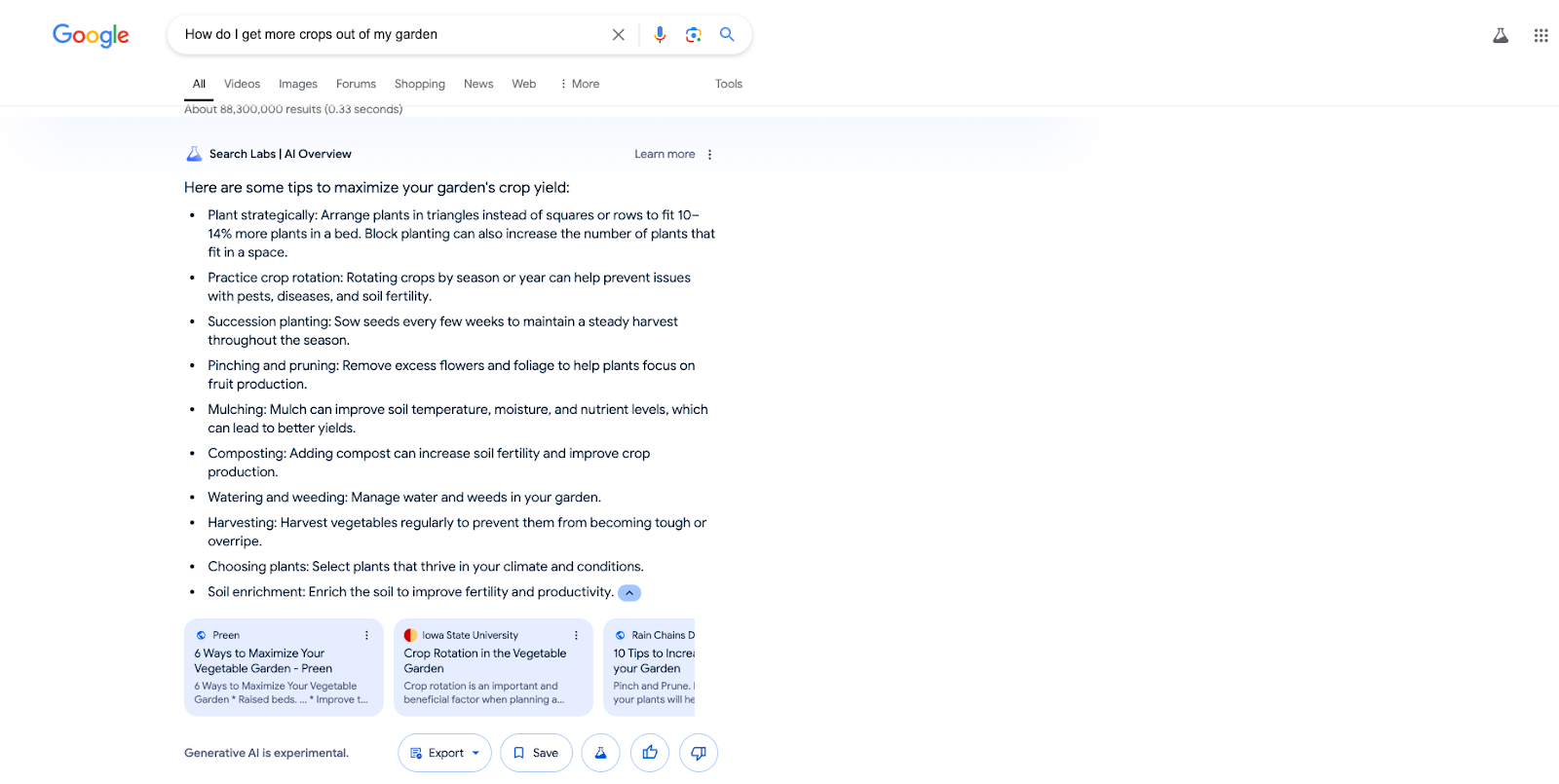
Notably, AI Overviews allow third-party sites and competitors to rank for your brand terms and related keywords. This shift can mean reduced organic rankings, more competition, and real traffic loss — one Ahrefs study found click-through rates for top-ranking pages drop by roughly 58% when an AI Overview appears. But it doesn’t spell doom for proactive brands. SEO experts like Bernard Huang, Founder of Clearscope, believe this change offers a unique opportunity for those who adapt strategically.
In an earlier episode of Skyword’s podcast, Content Disrupted: Bold Takes On Brand Marketing, Bernard shared actionable search strategies to help brands thrive in the AI Overviews era. Whether you’re looking to optimize your current strategy or explore new tactics, his insights are invaluable. You can listen to the full episode here, but to give you a head start, here are my top four takeaways:
1. Diversify Discovery Beyond Traditional Google Search
Google is no longer the only place — or even the only kind of place — where brand discovery happens. Two shifts matter. First, social, search-led channels like TikTok, Instagram, LinkedIn, and Pinterest now drive much of top-of-funnel demand, while traditional search shifts toward mid- and lower-funnel needs. Second, and newer: AI assistants are now discovery surfaces in their own right. People run product research and “best X for Y” queries directly inside ChatGPT, Perplexity, Gemini, and Claude — ChatGPT alone serves roughly 900 million weekly users. Whether you surface in those answers is fast becoming as consequential as where you rank on Google.
As always, optimize your content tailored to the specific formats and audience behaviors of each channel. For instance, you could create engaging video content suited for TikTok’s short-form format, detailed visual guides for Pinterest, or professional insights for LinkedIn to capture diverse audience interests and drive traffic back to your brand’s main site or other digital properties.
Recent data quantifies the shift: social platforms now account for over 60% of product discovery. Meta also reports Google searches per U.S. user are down nearly 20% year over year.
(One caveat on TikTok: following its 2026 divestiture to a U.S.-based joint venture, the recommendation algorithm is being retrained on U.S. user data, so distribution patterns may shift. It’s still a valuable channel — just watch your performance rather than assuming pre-2025 dynamics hold.)
2. Specialize Content Beyond Basic Informational Queries
AI now answers generic informational queries directly in the SERP, reducing click-through for basic “who, what, why, where” content. As AI increasingly dominates informational queries, traditional strategies of targeting high-volume keywords with basic content are becoming obsolete. To stay competitive, pivot towards specialization within your niche and dive deep into specific topics to build authority.
Google increasingly rewards topical authority — sometimes called topical cohesion — the degree to which a site shows deep, focused expertise on a subject rather than spreading thin across unrelated topics. (Internal attributes surfaced in the 2024 Google documentation leak, such as siteFocusScore and siteRadius, point this way, though Google hasn’t confirmed them as explicit ranking factors.) Either way, the practical takeaway holds: comprehensive, unique content that explores a subject’s intricacies wins. For instance, instead of offering generic marathon information, a site focused on running should provide detailed personal insights, including first-hand training experiences, common pitfalls, and preparation strategies.
That’s how a small university in Bloomington, Minnesota, with fewer than 200 undergraduate students and a contributing editor for Runner’s World’s personal website are able to appear in this AI Overview alongside a powerhouse brand like REI:
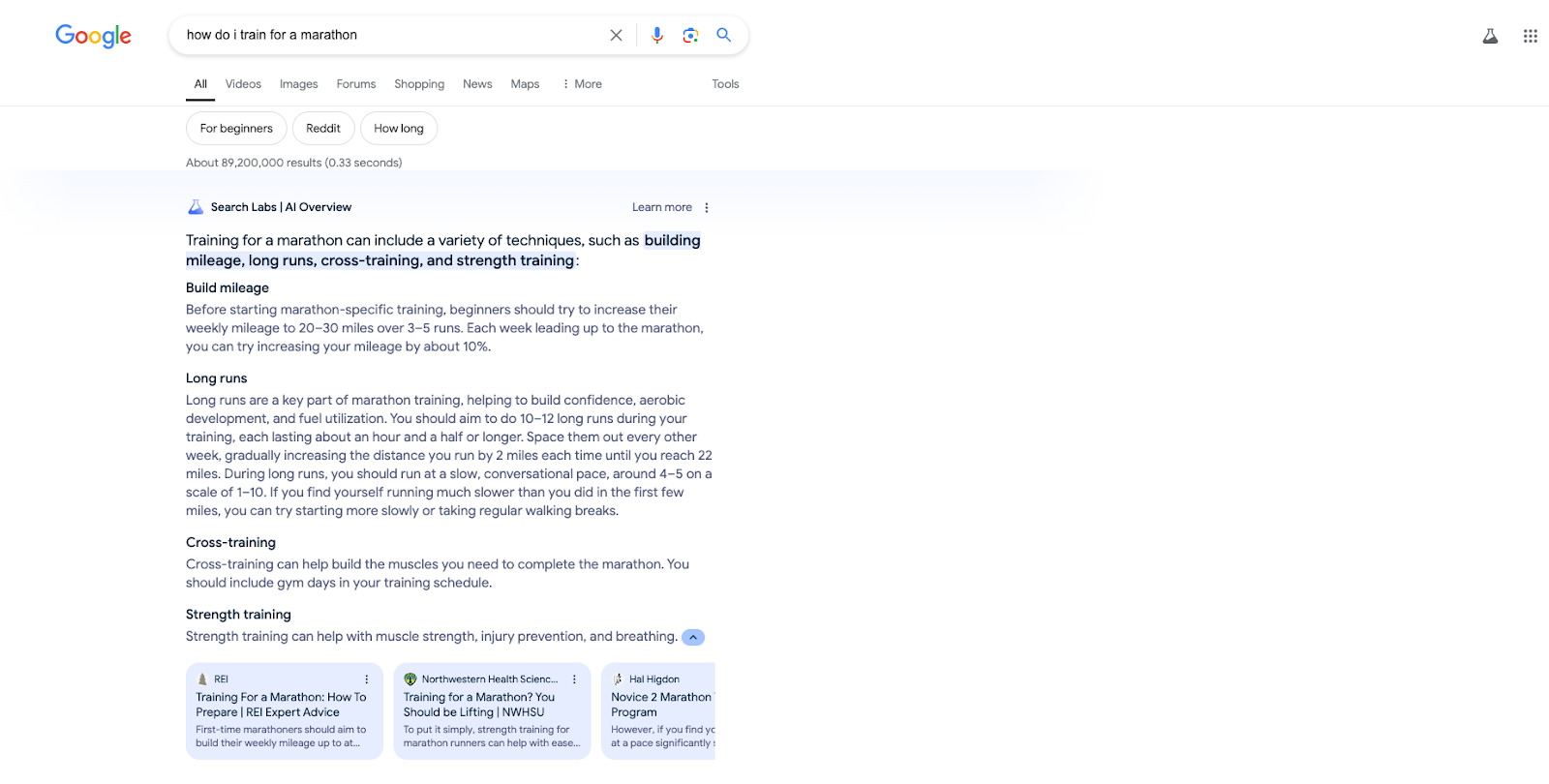
By producing in-depth, specialized content, you can differentiate your brand from larger competitors and align with Google’s efforts to combat the flood of commoditized content produced by AI. Although the search volumes for these specialized topics might be smaller, the aggregate effect of a well-developed library of granular, authoritative content can drive significant traffic over time.
3. Lead with First-Hand Experience to Satisfy E-E-A-T
Google’s algorithms now prioritize content with genuine opinions and unique perspectives over simple keyword optimization — and that shift gives an edge to brands willing to invest in authentic expertise.
The reason is supply. The surge in AI-generated content has flooded the web with commoditized information that any algorithm can replicate, so the differentiator is no longer coverage of a topic but evidence of real experience with it. Search engines are getting better at spotting that difference, though the sheer volume of automated material still makes it hard for Google to separate truly valuable content from generic filler.
That difficulty is exactly where established brands with high domain authority tend to win on default, and where newer brands have to work harder. Standing out takes more than traditional SEO practices — it demands first-hand expertise and authentic insights that genuinely resonate with audiences.
Used well, AI is a tool to enhance and scale human content creation, not replace it. It can generate ideas and streamline production, but compelling content still rests on human expertise and a point of view. Lead with E-E-A-T — Experience, Expertise, Authoritativeness, and Trustworthiness — to differentiate your brand and build credibility in an increasingly AI-saturated world.
Google has made this explicit: its quality rater guidelines now ask raters to weigh whether content shows “first-hand or life experience” — for example, expertise that comes from actually using a product or visiting a place — and its systems give even more weight to strong E-E-A-T on topics affecting people’s health, finances, or safety.
4. Structure Content So AI Systems Cite You as a Source
Being a topical authority is necessary but not sufficient — your content also has to be structured so AI systems can extract, evaluate, and reference it. This work now has a name: generative engine optimization (GEO), sometimes answer engine optimization (AEO). It isn’t a replacement for SEO but a parallel discipline, and it spans more than Google. The same content needs to earn citations across Google’s AI Overviews and AI Mode, ChatGPT, Perplexity, Gemini, and Claude — each of which retrieves and synthesizes sources a little differently.
A few things consistently help:
- Answer specific questions directly and completely. AI systems often break a query into sub-questions — “query fan-out,” searching each piece separately — and assemble an answer from whatever addresses each part. Content that resolves a precise question cleanly, near the top, is easier to lift and cite.
- Offer information gain. Provide what a model can’t synthesize from ten generic sources: original data, first-hand testing, expert commentary, a genuinely different angle. This is where E-E-A-T and GEO reinforce each other — the first-hand expertise that satisfies Google’s quality signals is exactly what makes you worth citing.
- Make your expertise machine-readable. Clear structure, descriptive headings, and structured data (schema for authors, credentials, publish dates, content type) help AI understand who’s behind the content and what it covers.
- Track AI visibility, not just rankings. Citation share, mentions, and sentiment inside AI answers are now their own metric, distinct from blue-link position — and a whole tool category exists to measure them.
- Let the AI crawlers in. You can’t be cited if you block the bots that do the retrieving — confirm your robots.txt permits crawlers like Google-Extended, GPTBot, PerplexityBot, and ClaudeBot, and that key content isn’t gated behind logins or scripts they can’t render.
By aligning your content with how AI systems actually retrieve and cite, you become a source they reach for — earning visibility, credibility, and referral traffic that increasingly arrives pre-qualified.
Accelerate Your AI-Era SEO Strategy with Accelerator360™
The arrival of AI Overviews in Google Search marks a significant shift in the SEO landscape. While traditional tactics may still hold value, a strategic pivot is necessary for brands to thrive in this new era.
Skyword’s Accelerator360™ is a powerful tool to expedite this adaptation.
Leveraging Accelerator360, you can:
Identify high-impact keywords that target specialized topics within your niche.
Generate targeted briefs that guide content creation towards in-depth exploration of those topics.
Select top-tier freelance writers with the expertise to deliver E-E-A-T content rich in Experience, Expertise, Authoritativeness, and Trustworthiness.
- Instantly repurpose SEO articles into assets — like email copy, social posts, and video scripts — for different channels and audiences.
Audit and optimize existing content to win in modern search.
Embrace the future of search with Accelerator360, and ensure your brand remains a trusted source in the age of AI-driven search. Ready to get started? I’m here to help.
Key Takeaways
- AI Overviews now sit above organic results on Google SERPs, allowing competitors and third-party sites to rank for your brand terms — reducing click-through rates for traditional informational content.
- Diversify beyond Google for top-of-funnel discovery. TikTok, LinkedIn, Instagram, and Pinterest drive demand generation, and AI assistants (ChatGPT, Perplexity, Gemini) are now discovery surfaces too — while Google shifts toward mid- and lower-funnel fulfillment.
- Specialize content to build topical authority. Google rewards sites that show deep, focused expertise on a subject — small, specialized publishers can outrank large competitors in AI Overviews by producing granular, authoritative content libraries.
- First-hand experience is now a differentiator. E-E-A-T content — featuring named experts, original perspectives, and lived experience — outperforms generic, AI-replicable content in Google’s evolved algorithms.
- Structure content for AI citation, not just human readability. Provide “information gain” (insights beyond basic facts), answer specific queries comprehensively, and align content with the query types AI systems prioritize.
Frequently Asked Questions
Q: Will AI Overviews completely replace organic search results?
A: No. AI Overviews supplement organic results by providing a summary at the top of the SERP, but the traditional organic listings still appear below. The key change is that AI Overviews can feature sources that don’t rank on the first page of regular Google results — meaning your current rankings don’t guarantee placement in AI-generated answers. Brands that adapt their content for both traditional SEO and AI citation have the best chance of maintaining visibility.
Q: How do I get my brand cited in AI search (Google’s AI Overviews, ChatGPT, Perplexity, and others)?
A: Focus on building topical authority through deep, specialized content rather than broad, surface-level keyword targeting. Produce content that offers “information gain” — unique perspectives, first-hand experience, and thorough explanations that go beyond what an AI system can synthesize from multiple generic sources. Structure your content with clear, direct answers to specific queries so AI systems can easily extract and reference your insights.
Q: Is investing in SEO still worth it if AI is answering queries directly?
A: Yes, but the nature of the investment shifts. Basic informational content that AI can answer directly (definitions, simple how-tos, listicles) will see reduced click-through. The highest-value SEO investment is now in specialized, experience-rich content that AI cannot easily replicate — and in ensuring your brand appears as a cited source within AI-generated summaries, not just in the organic listings below them.
Featured image by JovialFox at Adobe Stock.