

We’ve found the biggest obstacle in the ungated content debate isn’t making the decision, it’s having the wrong ideas about what content should be public, what should be exclusive, and why.
This article explains the new rules of AI visibility and introduces a practical framework for using public content to build authority and gated experiences to generate demand.
Today, 68% of Google searches end without a click and buyers routinely outsource research decision-making tasks to AI engines. Content strategies designed for click-throughs can’t compete in an instant-answer world.
Many marketing leaders recognize the implications for top-of-funnel content, but far fewer recognize the opportunity cost of keeping their most valuable expertise locked behind forms.
AI crawlers browse the web as logged-out visitors. They can’t bypass forms or access gated PDFs. If your cornerstone research, frameworks, and thought leadership are hidden, they can’t be crawled, cited, or synthesized by the AI systems increasingly shaping buyer decisions.
All this doesn’t mean every asset should be ungated. It means information and experiences now create value in different ways.
Why ungating content is an urgent decision
AI engines and zero-click search results are absorbing organic traffic at every stage of the buying journey, cutting off the paths that used to feed pipeline. Brands are in a high-stakes race to win visibility inside AI answers and stop the ongoing traffic collapse.
The knee-jerk response has been to optimize content pages for AI engines in order to gain AI search real estate. The assumption is that more indexible inventory translates to more recommendations.
At the same time, most enterprise marketers are sitting on a stockpile of gated resources. AI can’t crawl, cite, or synthesize content it can’t access, which means those assets contribute nothing to AI visibility. As competitors earn citations and recommendations from publicly available content, the pressure to ungate existing libraries has intensified.
The problem is, more ungated content doesn’t magically equal more AI visibility; more of the right kind of content shared in the right places, does<. AI engines favor brands that have a strong digital reputation and, specifically, content that demonstrates category authority: dense topic expertise, high information gain, and credible third-party endorsement.
To make the right decisions for your brand, you should be informed about the real tradeoffs and factors that determine success.
How AI citations and authority connect to pipeline
The link between AI visibility and revenue is real, but it forms earlier in the journey than most attribution models are built to see. Here’s the logic, in order:
Buying decisions are increasingly shaped by AI engines
Before a buyer reaches your site, they’re often asking AI to explain the category, compare approaches, and point to the vendors worth considering. Our 2026 research, involving 1,000 U.S. consumers, shows that this behavior is already mainstream: 46% of full-time workers have made a major purchase or important decision based primarily on AI-generated information, and 52% of all consumers are using AI more than they were a year ago.
The shift isn’t being driven by GenZ. AI-first research correlates more with household income and education than age group. Our research revealed that consumers in households earning $100K+ are roughly 2.5x more likely to start their research with AI than those earning under $50K. At the $200K+ income level, that gap approaches 4x.
This behavior is amplified in an office setting. According to a 2026 Forrester report, 94% of B2B decision-makers used a large language model in their purchase process in 2025.
AI answers and recommendations drive real action
47% percent of consumers have taken a significant action based on what AI told them about a brand:
- 19% have avoided a purchase
- 17% have been convinced to switch brands
These aren’t passive research behaviors. They’re decisions made, purchases lost and brand perceptions shaped by information that, very likely, didn’t come from your brand.
Buyers use AI to form the first opinion and third-party sources to verify
Most buyers don’t implicitly trust AI to tell the truth, but they don’t trust brands, either. When AI conflicts with a brand’s own claims, 54% of buyers seek third-party validation; only 29% treat the brand as the source of truth on its own products. If your brand has a strong digital reputation in the places your buyer goes to verify, you have a powerful recommendation engine in play.
Brands with category authority are more likely to be favored when buyers research
The brands that shape AI recommendations have a strong combination of category positioning (there’s clarity around what they’re known for) and signature thought leadership (they’re sought after for their fresh insight and unique category point of view). These qualities tend to determine how often your brand name will surface in un-branded category questions, how often your content is included in the answer over competitors, and how accurately you’re represented in answers.
This visibility triggers downstream behavior that can be measured in correlation with citation and share of model metrics:
Branded search lift: When buyers are ready to transact or validate what they found from AI-assisted research, they leave the AI platform to search for your company explicitly by name.
Higher quality leads: Prospects self-educating with AI are less likely to linger in your nurture campaign. By the time they hit your request demo CTA, they’re more likely to be qualified and ready to buy.
The takeaway: Authority precedes pipeline. Treat growing citations and share of model as your leading indicators of pipeline, and branded search lift and higher quality inbound leads as the signal that it’s driving a more effective pipeline.
“We see enterprise brands clinging to gated PDFs because they fear losing pipeline, but the data shows those leads were already degrading. When you un-gate category-defining research, you don’t lose the buyer; you meet them in the AI chat where they’re actually building their opinions on the category and narrowing down the vendors in their consideration set.” –Andrew Wheeler, CEO, Skyword.
What marketers need to understand about how AI engines “process” content
If you’re weighing the pros and cons of ungating, you should have a basic understanding of the factors that make content citation-worthy. These are baseline principles that many marketers miss.
The baseline rule: AI bots can’t crawl gated content
Ungating your content doesn’t instantly guarantee you’ll show up in AI answers. All it does is give AI bots (like GPTBot, ClaudeBot, PerplexityBot, and Google-Extended) the chance to crawl your pages. That crawl is the absolute baseline requirement to even be considered.
Anything you leave locked behind a leadgen form is completely invisible to them. Unless that exact information lives out in the open somewhere else, it’ll never enter the AI’s dataset, which means it can’t be used, quoted, or cited when buyers ask questions. Basically, a gated asset contributes zero to your AI visibility, your model credibility, or the conversations buyers are having with chatbots.
Your entire public body of work informs how you’re described by AI engines
If an AI engine is asked about your brand, the answer will be based on the entire body of information they can access: what you publish, what others publish about you, and how those pieces connect across the web.
When an AI answers a question, it isn’t retrieving the one page that ranks highest. It’s synthesizing the ‘right’ answer from what it thinks are the most ‘credible’ sources on the topic.
That changes what creates competitive advantage. A large content library matters less than a strong body of original, credible information. Brands earn authority when their expertise, products, and people are consistently associated with the topics buyers care about, and when those associations are reinforced by other trusted sources across the category.
Legacy content can pollute visibility
Anything that’s currently public can also impact how your brand is framed inside these answer engines. Remember, generic advice gets summarized without a source because AI treats it as common knowledge. Un-gating or publishing more of this kind of ‘commodity’ content has a neutral to negative impact on your AI search visibility. Thin, generic, or promotional content dilutes topical authority, burns through your technical crawl budget, and trains AI systems to ignore your content, without adding the new knowledge, data, or point of view that makes it original and ownable.
Similarly, the more legacy noise you leave indexable, the more you risk confusing the model and being misrepresented in AI answers. We see this play out all the time in a few different ways:
- A buyer researches your product using an AI engine, and its summary includes the wrong product details, extracted from a competitor’s comparison table.
- An AI answer misrepresents your positioning because it’s scraping an old corporate microsite that contradicts your current point of view.
- A buyer asks an AI engine to rank vendors and you’re bottom-of-the list because of a cluster of old reviews or Reddit threads you didn’t even know existed.
Content value compounds through circulation
Circulation is how content earns the third-party validation that AI engines look for when deciding whether or not information is credible. It’s how your research gets cited, your framework gets referenced, and your point of view becomes associated with the category in AI engines.
AI is far more likely to trust knowledge that has been corroborated across multiple credible sources than knowledge that exists only on your website. Content hidden behind a form can’t build that network of validation at all.
The real cost of gating content
Gating carries compounding opportunity costs that most marketers aren’t well-informed about.
Losing exposure
A gate doesn’t just hide content from AI engines. It limits how far your expertise travels through the trust network buyers rely on to validate purchase decisions. Gated work doesn’t get quoted by journalists or referenced by analysts. Creators can’t build on it, practitioners can’t share it with peers, and buyers can’t forward it to their committees. Every missed handoff is one fewer independent source endorsing your brand’s credibility.
Limiting third-party endorsement
Meanwhile, buyers are placing more weight on third‑party sources than on brand-owned claims. When AI-generated information conflicts with what a brand says about itself, only a minority of people default to trusting the brand, and more than half go looking for outside sources before they decide. Your expertise doesn’t become more credible because you publish it. It becomes more credible because other people can reference it. A gate interrupts that.
Not gaining credit for your best work
When your definitive research sits behind a form, the model cannot attribute the insight to you, and a competitor’s open, weaker version becomes the cited authority on your own thinking. That makes credit density the real defense of thought leadership: name the framework, document the methodology, publish the originating source, timestamp the finding, and reinforce it across channels until credible third parties cite it. The test is not whether a competitor could read the idea, but whether the market, when it repeats it, knows the idea came from you.
Overall, the cost is losing authority to competitors
The losses add up, and they escalate. Short-term you’re missing from the specific, real-time questions where your content would help most: AI doesn’t know you have relevant information worth surfacing, so it cites another source or competitor. Over time, the quiet loss compounds: your brand name may be associated with the category but it’s not known for anything in particular. Gradually, you lose the ability to be the source of truth on your own brand and products.
A simple and effective blueprint for ungating content and capturing leads:
To create and capture demand in this environment, brands should evolve their traffic-based content strategies by developing two functional portfolios that act as single compounding flywheel: an open Authority Portfolio engineered for public visibility, and a gated Conversion Portfolio optimized for high-intent actions.
Defining Your Public Portfolio (The Authority Portfolio)
Your public portfolio is an “open by design” repository of your company’s most distinctive, indexable knowledge.
Its core objective is to maximize reach, establish undeniable topical authority, and earn citations within AI search engines like ChatGPT, Claude, and Perplexity.
The line between what stays open and what gets gated depends on a simple admission test:Does gating this asset cost you a citation you would otherwise earn? If the asset contains written, indexable knowledge that shapes category preferences, it belongs in the open public portfolio. Depending on your go-to-market model, the inventory for this portfolio should include:
- For B2B strategy: Original research reports, industry benchmarks, proprietary frameworks, tactical playbooks, comprehensive how-to guides, product comparison pages, and standalone expert analysis.
- For B2C strategy:Buying guides, product comparisons, tutorials, industry trend reports, expert product reviews or roundups, and behind-the-scenes explainers.
By keeping these assets fully open, you ensure your brand becomes the raw source material used by AI models and human influencers to define your category.
Maximizing the value of your ungated assets
Simply removing a form fill from an old PDF is insufficient; a public portfolio only compounds visibility if the underlying assets are optimized for the technical and editorial standards of modern search. To maximize the impact of your public assets, implement a three-part framework focused on quality, architecture, and structural distribution:
1. Inject high information gain
AI engines and sophisticated buyers discard generic commodity content. To earn influential reshares and AI citations, every public asset should clear the editorial and technical standards of modern discovery. We’ve boiled these down to the Category Authority Standard™ — four core pillars that brands should use to evaluate and optimize every asset for modern discovery.
- Proprietary data: The infusion of exclusive datasets, original research, and internal findings that a model cannot locate in its general training data and a competitor cannot replicate.
- SME lived experience: The embedding of first-hand perspectives and real-world learnings from named experts. AI heavily weights lived experience because it cannot synthesize authentic human practice on its own
- Challenger logic: Your brand’s distinct, defensible, and contrarian position on the topic that cuts through the lazy consensus of your category. The market quotes and cites the brand that corrects the status quo.
- Structural citability: The structural elements that make content easy for AI to understand. Crawlers struggle to parse PDFs, even when they are public. Public assets must be built as clean, schema-marked HTML using proper header structures and answer-box formatting so models can seamlessly extract and attribute your logic.
2. Atomize and merchandise the expertise
Never treat a major intellectual asset, like proprietary research, as a single static asset. Instead, treat the core asset as raw source material. Maximize its public surface area by atomizing it into dozens of targeted, crawlable formats:
- Publish core findings as schema-marked web pages.
- Convert complex internal methodologies into standalone, extractable tables and clean data visualizations.
- Draft executive perspectives and expert opinion pieces attributed to your internal leaders.
- Develop structured, text-based FAQ pages that AI engines can easily scrape for direct answers.
3. Use native formats to boost circulation
Content accrues competitive advantage through circulation. Every time your work is cited or reshared, it builds attribution density at scale: repeated associations between your brand and the knowledge that defines the category, which is what feeds favorability and exposure inside AI models. And because some of that credibility is earned by who picks the work up, the more you design content for credible third parties to more easily mention and reshare it, the more the flywheel turns.
The public portfolio does not replace lead generation; it accelerates it by changing the sequencing of the funnel. When you share your expertise openly, you build widespread category authority and trust. This authority naturally attracts more pre-educated, high-intent buyers and decision-makers.
Defining the conversion portfolio (gated by design)
If the open authority portfolio is engineered to share your expertise in the open where it builds reputation and reciprocity, the conversion portfolio is the engine designed to apply that expertise to the individual through personalized deliverables or experiences that only your data set or network can deliver.
- For B2B customer journeys: Interactive diagnostic tools, customized ROI calculators, configurators, live product workshops, deep-dive executive roundtables, private advisory sessions, bespoke organizational assessments, 1:1 strategy sessions, and live briefings.
- For B2C customer journeys: Personalized consultations (e.g., in-store skincare or custom styling sessions), product customization tools, virtual try-ons, exclusive product drops, VIP customer experiences or events, membership communities, fan access networks, and early-access previews.
Maximizing your conversion portfolio: the gated content matrix
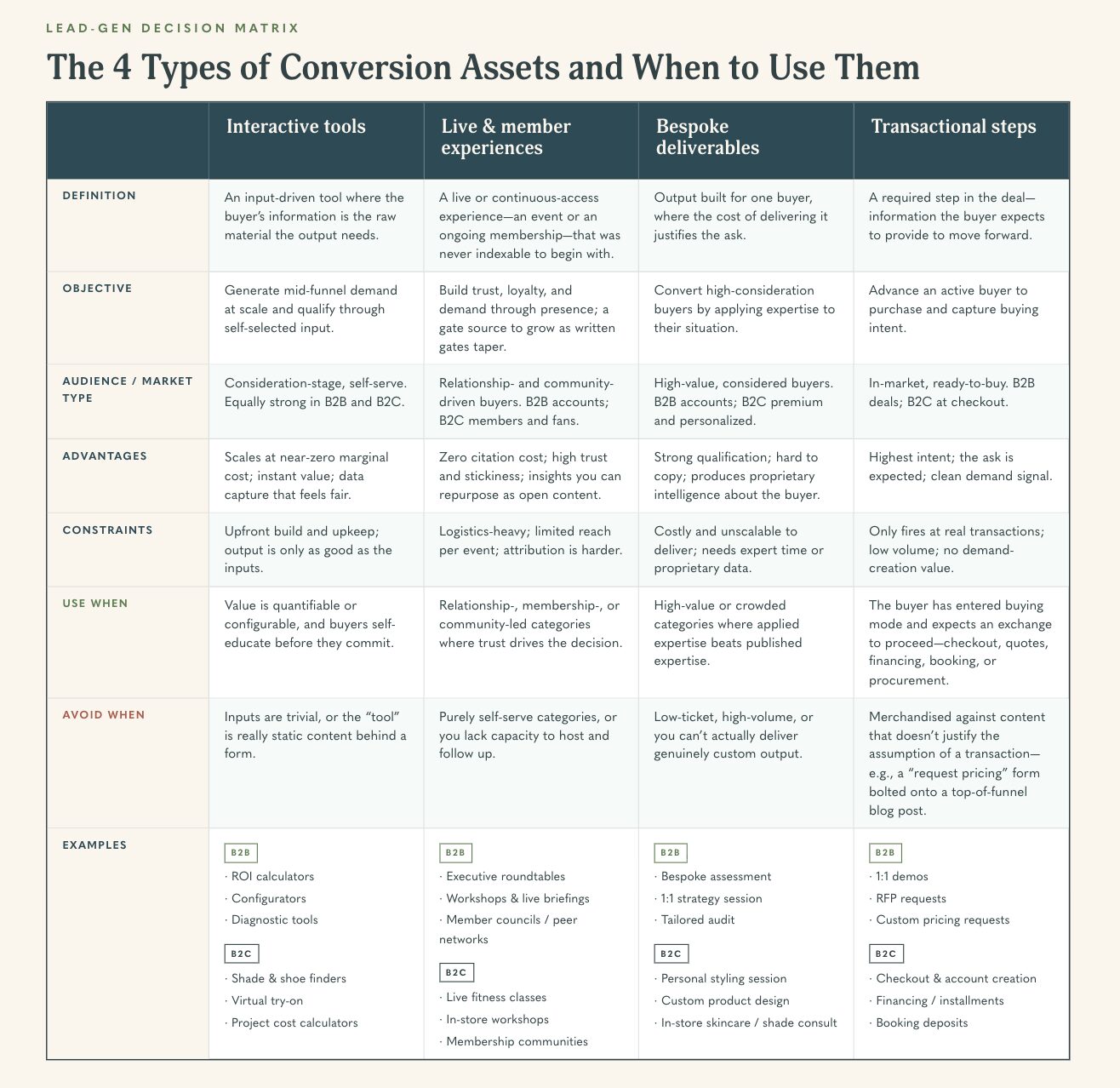
To extract the maximum value from your conversion portfolio, you must move away from soft-gating static text and lean heavily into structural formats where the output directly justifies the ask. We maximize lead acquisition by restricting our gates to four precise frameworks.
1. Interactive tools
These are input-driven artifacts where the buyer’s unique data serves as the raw material the tool requires to function. Examples include project cost calculators, shade finders, and business diagnostic tools. This scales at near-zero marginal cost, provides instant, quantifiable value to the prospect, and secures highly qualified data capture that feels inherently fair to the user. Avoid using this approach if your “tool” is simply a static whitepaper masquerading behind a form.
2. Live & member experiences
This framework prioritizes relationship- and community-driven engagement through physical or digital presence, focusing on assets that were never indexable by AI crawlers to begin with.Think peer networks, executive dinners, and member councils. This approach yields high trust and customer stickiness with zero citation cost, while simultaneously generating qualitative buyer insights that can be fed right back into your open content loop.
3. Bespoke deliverables
Reserved for high-consideration buyers, this involves output built uniquely for an individual or account where the sheer cost of delivery justifies the information exchange. Examples include tailored audits, custom product designs, and 1:1 strategy sessions. It signals exceptionally strong qualification, creates a highly defensible competitive advantage, and generates deep first-party intelligence about your buyers’ actual operational environments.
4. Transactional steps
This covers the required steps in an active deal or purchase cycle where the buyer inherently expects to provide data to advance toward a resolution. In B2B, this maps to custom pricing requests, RFP submissions, and 1:1 product demos; in B2C, it captures financing applications, booking deposits, and account creation at checkout. It represents the highest possible demand signal, though it should never be merchandized inside top-of-funnel content that hasn’t earned that level of transactional intent.
Conversion asset decision matrix
Make the knowledge you have that AI can’t replicate public so it can be discovered, cited, and associated with your brand. Reserve gating for the custom analysis, personal benchmarks, peer workshops, and other experiences that only your business and products can deliver.
Activating the flywheel connection
You maximize the conversion portfolio by recognizing that it cannot exist as an isolated silo. It relies entirely on the reputation established by the authority portfolio upstream. The more effectively your open work positions your brand as the definitive authority within AI search environments, the more eager buyers will be to cross the gate to receive your custom analysis, access your private events, or secure an hour of your team’s time.
Ultimately, the deep qualitative insights, specific pain points, and buyer data collected during these private conversion experiences become the exact inputs needed to build the next iteration of your open, authoritative public content. The loop closes, the wheel turns faster, and your category authority compounds with every single cycle.
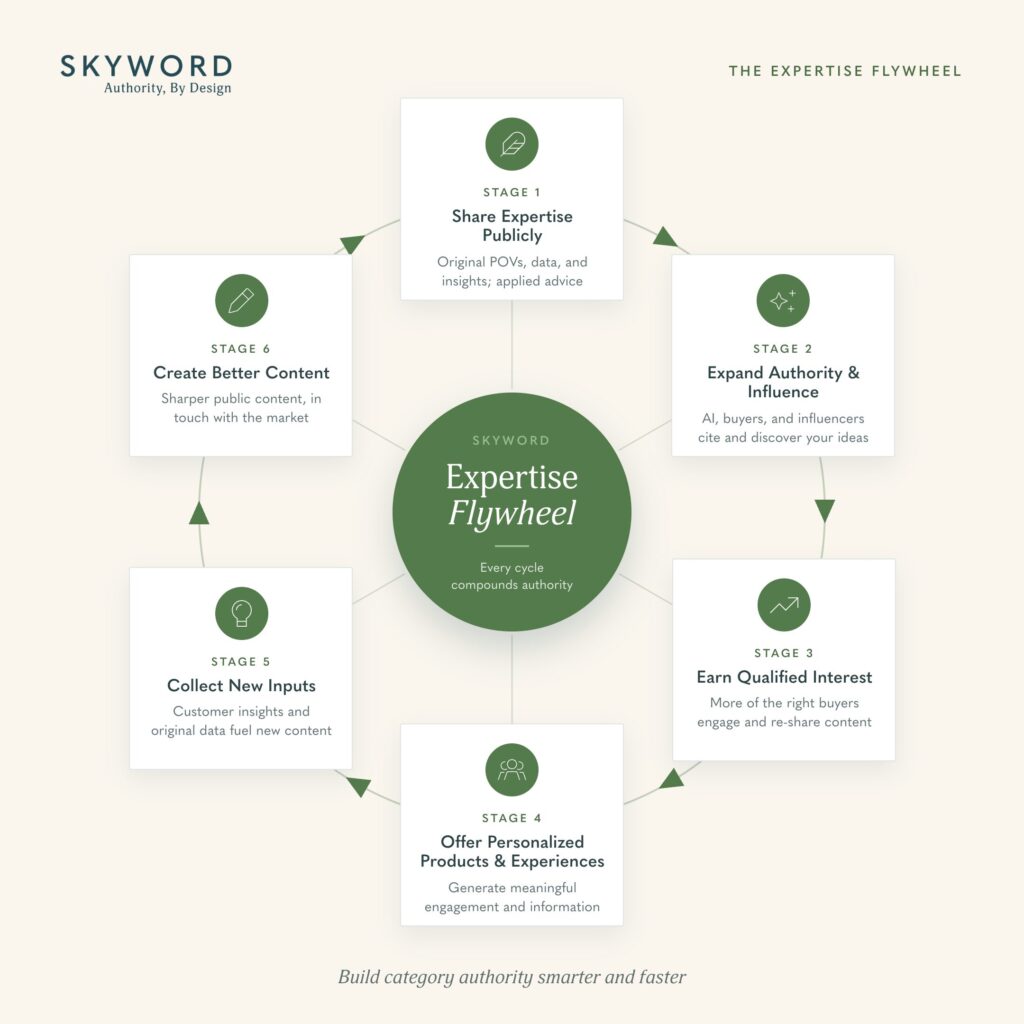
Treat the two portfolios as a flywheel, not two separate piles.
This visibility feeds a continuous, six-stage compounding loop that shifts our focus from manufacturing friction to capturing authentic intent:
- Stage 1: Share Expertise Publicly:We publish our original points of view, proprietary data, and deeply applied advice out in the open where the market can engage with it.
- Stage 2: Expand Authority & Influence: By removing the gate, we clear the path for AI engines, target buyers, and industry influencers to natively discover, crawl, and cite our ideas. This builds the critical mass of public “attribution density” that embeds our brand into today’s AI-generated shortlists.
- Stage 3: Earn Qualified Interest: Widespread circulation warms the market, attracting a higher volume of the right buyers who actively engage with and re-share our content.
- Stage 4: Offer Personalized Products & Experiences: Pre-educated by our open content, these high-intent prospects willingly step forward to exchange their information for exclusive, interactive value that an AI assistant cannot replicate—such as custom ROI calculators, bespoke diagnostic tools, live roundtables, or 1:1 strategy sessions.
- Stage 5: Collect New Inputs: The deep qualitative insights, buyer challenges, and original data uncovered during these private, high-value interactions are captured directly by our teams.
- Stage 6: Create Better Content:We feed those fresh first-party inputs back into the top of the flywheel to produce even sharper, more market-aligned public content, turning the wheel faster and compounding our category authority with every single rotation.
Tips for ungating your existing asset library
Most enterprise programs are sitting on a gated library built for a model that no longer works. Un-gating those assets is only half the job. A PDF dragged out from behind a form is still commodity content unless it earns the citation.
- Audit the existing gated library by AI citability, not traditional value. For each asset ask whether an AI could accurately summarize it in 200 words or fewer. If yes, the gate is protecting the appearance of exclusivity, not genuine insight; those assets are your first candidates to open and merchandise.
- Prioritize by category authority impact. Start with assets already ranking for category-defining terms. Un-gating these carries the lowest disruption risk, because the open version begins accumulating AI citations the gated version never could.
- Convert PDF-based assets to HTML. Crawlers cannot reliably parse PDFs, especially behind gated pages. Clean, structured HTML with schema markup is the technical precondition for citability; a PDF earns no AI authority even after the gate comes off.
- Redefine lead-capture triggers around intent, not access. A buyer downloading a full implementation guide is expressing different intent than one reading a blog post. Design capture to match the signal, not to extract an email from every asset regardless of stage.
- Track AI visibility alongside MQL volume. Your sales organization needs evidence that the shift changes which pipeline is visible rather than shrinking it. Track AI citation frequency, referral quality from AI sources, and lead quality (sales-cycle length and close rate) for the two portfolios, before and after.
- Run a controlled pilot before committing the full library. Un-gate the top three to five information assets from the existing library and monitor outcomes over 60 to 90 days before scaling. That gives the CMO the internal evidence to manage sales-organization concerns with data rather than conviction.
How to ungate, upgrade, and re-merchandize existing content
The table below pairs 6 common types of gated assets with sample upgrade recommendations: how to enrich the asset against the four pillars (proprietary data, SME lived experience, challenger logic and structural citability) so it becomes citation-worthy, then how to re-merchandise it into public assets. The genuinely interactive, personalized and transactional assets that stay gated are covered in the matrix that follows.
| Gated Asset (Behind a Form Today) | CAS Upgrade Opportunities | How to Re-merchandise It |
|---|---|---|
| Whitepaper or thought-leadership PDF | Replace borrowed stats with proprietary data and add a named expert’s first-hand read (SME lived experience). Sharpen the argument into a challenger stake distinct from category consensus, and rebuild as schema-marked HTML with standalone headers (structural citability). | Republish as crawlable HTML, then atomize into a key-findings post, a framework explainer, an executive perspective and an AI-parseable FAQ, all attributed to named experts. |
| Original research report | The original dataset is already your strongest citation signal: foreground the proprietary findings and add SME interpretation of what they mean. Frame the results against the consensus they overturn (challenger logic), and mark up every chart and table as structured data. | Open the findings, charts and methodology summary to earn citations; move the full dataset and an interactive data explorer into the conversion portfolio. |
| Industry benchmark guide | Anchor to your own benchmark data rather than aggregated third-party numbers (proprietary data), and add practitioner commentary on the outliers (SME). Take a position on what “good” should mean (challenger logic), and publish the norms as clean, extractable tables. | Publish the benchmarks and category norms openly; gate a tool that scores the buyer against named competitors. |
| Ebook or how-to guide | Swap generic best practices for a named, proprietary methodology, and embed lived-experience examples and failure modes from your experts (SME). Take a contrarian stance where the category is lazy (challenger logic), and break the steps into HowTo schema (structural citability). | Break into a public how-to series, explainer articles and short video; rebuild or retire any section that no longer reflects your position. |
| Gated webinar or recording | Lift the speaker’s first-hand stories, specifics and any original data into text (SME + proprietary data), and lead with the provocative claim rather than the agenda (challenger logic). Publish a structured transcript with timestamps and Q&A schema (structural citability). | Publish the transcript, key takeaways and a written recap, and clip for social; reserve gating for live, interactive sessions. |
| Case study (no confidential data) | Quantify the outcome with real numbers (proprietary data) and include the client’s own words (SME lived experience). Frame the approach against the default the market would have chosen (challenger logic), and structure it problem-approach-result with schema (structural citability). | Publish the outcome and proof points openly as citable evidence; gate only versions that contain confidential client data. |
Two low-risk ways to test ungating strategy on new assets
If your team is anxious about pipeline stability, you don’t have to guess whether this works. You can use two low-risk testing structures on your next wave of content to gather your own internal data:
- Option 1: The Time-Based Bridge: Gate a new cornerstone asset for a fixed window (like 30 days) and run active promotion against it to capture standard lead volume. At the end of the 30 days, take the gate off entirely and release it to the open web as schema-marked HTML. Track what happens next: look for lifts in AI citations, branded search volume, and deep downstream conversions once the asset is discoverable.
- Option 2: The Tiered Value Model: Publish the complete, core framework un-gated from day one so AI engines can crawl and cite your ideas immediately. Then, gate a high-value “director’s cut”—an enhanced version packed with surplus value like raw datasets, implementation templates, or a companion interactive tool. This ensures you never sacrifice visibility by taking your primary citation asset out of circulation, while still capturing high-intent leads from buyers who want to execute your ideas right away
A caveat in option 1: The time-based bridge is not a clean controlled experiment. The gated window benefits from active promotion and freshness; the un-gated window is typically a passive, aging asset picked up by organic and AI discovery over time. Do not oversell it as an apples-to-apples test. A sharp analyst will spot the confound. What it gives you is a low-risk, real-world way to get comfortable with the shift, and directional evidence, gathered over multiple assets and cycles, of where the durable value actually accumulates.
Anticipating internal resistance and how to answer it
Sales resistance: “We’ll lose our leads”
The response: move the conversation from MQL volume to MQL quality, and bring the pilot data instead of asking for trust. A buyer who read three authority pieces before requesting a demo has a measurably shorter cycle and higher close probability than one who filled out a form for a whitepaper they never read. And human sellers do not disappear: a 2026 Gartner survey found 69% of B2B buyers turn to sales reps to validate AI-generated insights. Open content feeds better-prepared conversations; it does not replace them.
Legal and compliance: “We can’t give away proprietary data”
The response: distinguish data that is legally or competitively sensitive from content that merely feels sensitive because it has always been gated. Original research containing customer or patient data stays in the conversion portfolio. Category perspective, methodology framing and thought leadership do not carry the same risk. Build a classification rubric with legal, not a blanket restriction.
Attribution: “How do we prove open content drives pipeline?”
The response: accept that AI-influenced pipeline requires different measurement, and track citation frequency alongside pipeline velocity rather than instead of it. A buyer who first met you in a ChatGPT answer, read two open articles and requested a demo weeks later shows up as a branded or direct conversion in legacy attribution, but your AI visibility drove the first trust signal. Supplement MQL tracking with AI brand-mention monitoring, an approach covered in depth in Skyword’s work on moving from rankings to presence.
AI engines reward authority, not inventory
The gating itself was never your brand’s competitive advantage. The authority behind it was. In an AI search environment, authority you cannot see cannot be cited, and authority that cannot be cited does not shape the shortlist. We spent 15 years training brands to publish at scale, and a lot of them are realizing they built inventory for answer engines that hand them no credit for it. Merchandising your best thinking into a public authority portfolio is how you become the source AI cannot leave out, while you save the gate for the moment a buyer is genuinely ready to trade intent for value.
So treat this as an operating-model decision, not a content tactic. The principle is simple to say and hard to do: make your expertise public, and make its application exclusive. The brands that get it stop chasing a page rank and start building the authority infrastructure the AI search era rewards, the authority-based content program that earns the citation, shapes the shortlist, and shows up in your buyer’s decision long before a form ever enters the picture.
Frequently Asked Questions
Will un-gating content actually reduce the leads my sales team depends on?
Raw MQL volume from those specific assets may dip, but the leads that remain skew higher-intent, because buyers arrive pre-educated by open content that AI has cited. Run a 60- to 90-day pilot on three to five assets and compare close rate and sales-cycle length (not form-fill counts) before scaling. In most programs the quality gain offsets the volume dip.
Which types of content should always stay in the conversion portfolio?
Content AI cannot replicate or accurately summarize: original first-party research with full methodology and data, interactive tools and ROI calculators that require user input, and personalized assessments or 1:1 sessions. The gate here converts genuine intent rather than manufacturing scarcity. Keep a public abstract so AI can still cite you as the source.
Isn’t soft-gating (publishing part of an asset and gating the rest) the safe middle ground?
Soft-gating can work as a temporary bridge while you transition off a fully gated model, but it is a weak destination rather than a strategy. It asks one asset to do two jobs at once (earn AI citations and capture leads) and usually does both poorly: the gated portion still cannot be crawled or cited, and the open teaser is often too thin to earn either the citation or the buyer’s trust. The stronger model splits the work into two purpose-built assets (an open piece engineered to be cited, and a genuinely exclusive experience worth a buyer’s information), so each does one job well.
How do AI crawlers access gated content, and is there a technical workaround short of full un-gating?
They don’t. GPTBot, ClaudeBot, PerplexityBot and Google-Extended act as logged-out visitors and cannot authenticate or submit forms, and there is no compliant trick that changes this. Publish the insight you want cited as open, crawlable HTML, and reserve the gate for genuinely exclusive or transactional value. Cloaking or hidden text that shows crawlers what humans cannot see violates search-engine guidelines and risks penalties.
How do we measure pipeline impact when form fills are no longer the primary signal?
Track AI citation frequency and share of model alongside influenced-pipeline metrics, and watch lead quality (close rate and cycle length) rather than volume. Many AI-influenced buyers surface later as branded or direct conversions, so pair MQL tracking with AI brand-mention monitoring to avoid undercounting the channel that is actually growing.