Content Marketing
How AI Helps Marketing Teams Scale Content Without Sacrificing Quality
By Andrew Wheeler on May 20, 2026
AI can help marketing teams keep up with rising content demand without sacrificing quality — but only when it is used to adapt original, human-created content rather than generate content from scratch. The most effective approach uses AI-powered content atomization: taking a single high-value asset like a whitepaper or research report and using natural language processing to automatically produce tailored versions — blog posts, email copy, social posts, landing pages — for different channels and personas. Human editorial review remains the final quality gate. This is the model we built at Skyword, and the distinction between AI-adapted and AI-generated content is what separates scalable quality from scalable risk.
Subscribe to our monthly newsletter, Content & Context, to receive more insights and updates on the content marketing world from Skyword CEO, Andrew C. Wheeler.
The Content Creation Paradox Enterprise Marketers Face
Recently, I spoke with a CMO whose brand had invested hundreds of thousands of dollars in an experience optimization platform that his team is struggling to use.
Why? Because, at the end of the day, his team is responsible for creating the entire library of personalized, modularized content that the platform needs available to do its job. Imagine every piece of content across their digital journey has to be tailored for at least six different audience personas that the technology is programmed to recognize. And that content creation needs to be maintained continuously.
That’s not to say their effort and others like it are foolhardy, far from it. His brand has embraced a reality that all marketers now face: buyers expect best-in-class digital experiences that make it easy to instantly get the specific information they need through the format(s) and channel(s) they prefer.
The truth is, traditional methods of creating content don’t scale to meet the volume, speed, and budget requirements needed to deliver today’s version of an optimal customer experience. Unfortunately, this fact is forcing marketers to make compromises they know won’t serve the business: sacrifice content quality, scale back content production and —therefore — results, or ramp up spending on resources and cut into profit margins.
As a result, brand marketers are stuck in a content creation paradox. An explosion of digital channels (social platforms, email, digital hubs, streaming media, etc.), and the demand for relevance and personalization across those channels, have made it virtually impossible for marketing teams to keep up with content demand — even with the support of advanced distribution technology.
Something has to give.
How AI-Powered Content Atomization Solves the Scale Problem
At Skyword, we set out to solve this challenge with Artificial Intelligence (AI). After all, AI applications like natural language processing (NLP) and image recognition are fundamental to how search and social platforms — Google, Instagram, LinkedIn, and others — have evolved how they process and deliver content to users. So, couldn't the same advancements be used to benefit marketers?
The answer is yes. And the result is our Content Atomization feature in Accelerator360™, which applies AI in two significant ways:
Atomization: Turning One Asset into Many
NLP technology has gotten really good at recognizing, extracting, and synthesizing key information from text. Calibrating these capabilities to the needs of specific content types in Accelerator360™, users can now identify a primary piece of written content — such as an article, whitepaper, or video transcript — and use AI to adapt that text into different versions for different content types.
For example, instead of publishing your latest whitepaper and then separately creating landing page copy, an article, email copy, and three social posts that tie back to it, Skyword’s Content Atomization AI can synthesize the information in the whitepaper and generate each of those related assets for you within moments, then alert you that those assets are ready for human review.
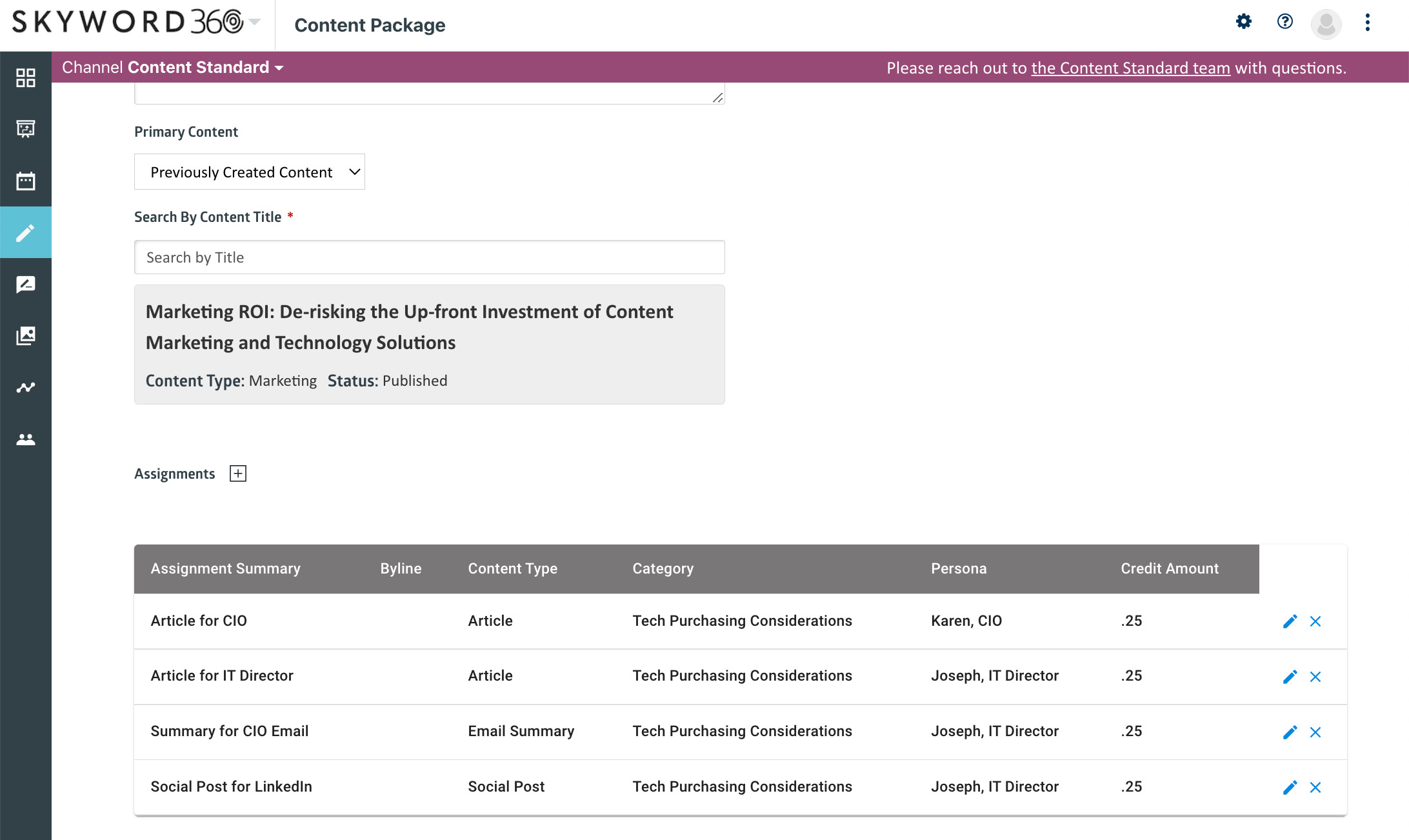
Identify an original piece of Primary Content and the additional adaptations you need.
Personalization: Tailoring Each Version for Specific Personas
If you’ve ever used a tool like Grammarly, you know that NLP technology is also capable of “reading” text and customizing it to match a desired tone, style, and context. Similarly, our Content Atomization feature allows users to customize the different versions of content they need for specific personas.
The characteristics of each of your personas in Accelerator360™ tell the platform which NLP model should be used to adapt content whenever a particular persona is selected. We’re also applying AI to recommend imagery most relevant to that persona for inclusion in the content.
So, you can automatically generate additional assets based on a primary piece of content and have versions of each asset tailored to each persona you’re targeting.
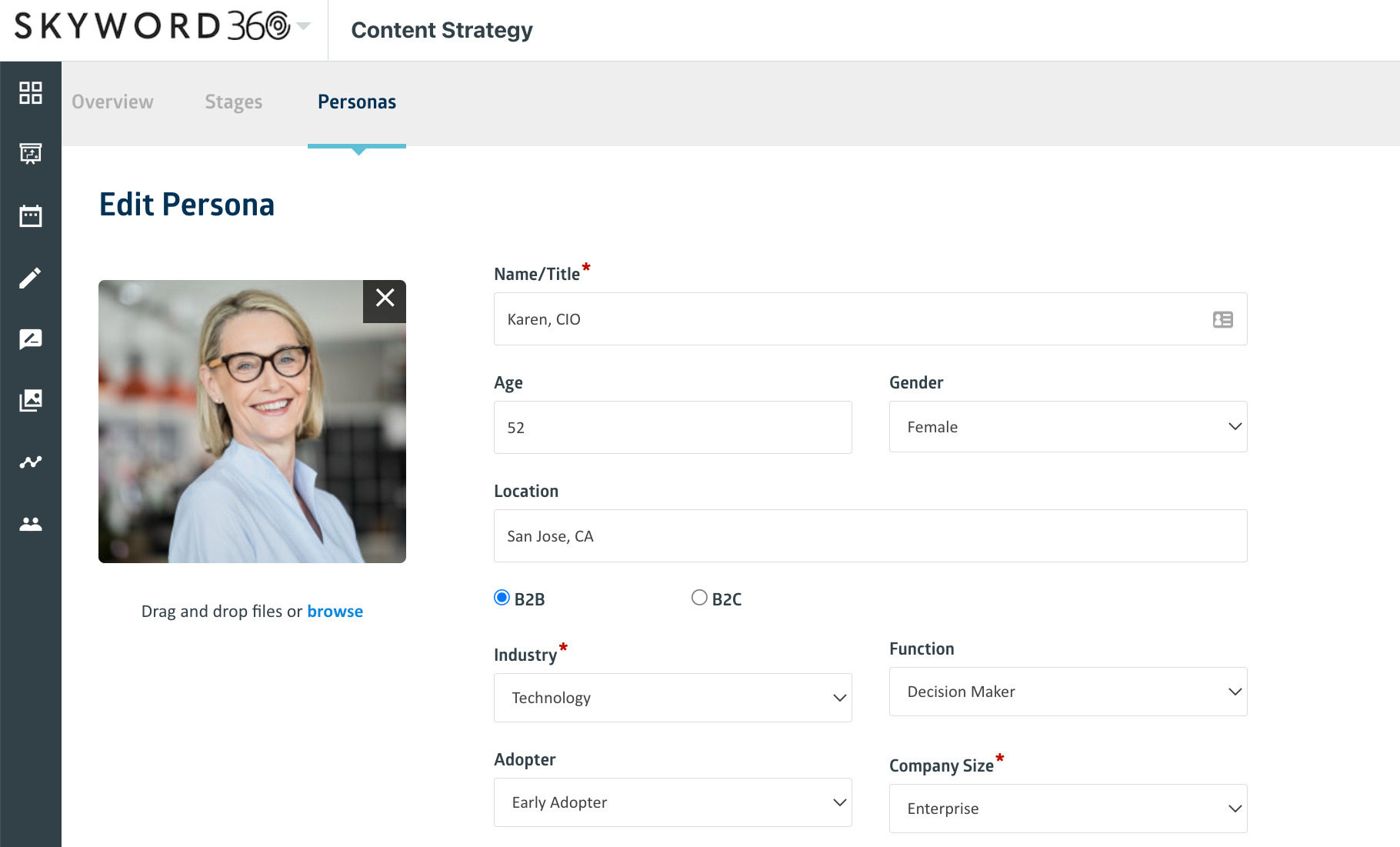
Accelerator360™ automatically sends your content to the NLP model that matches your Persona descriptors.
Why AI-Adapted Content Outperforms AI-Generated Content
At Skyword, we firmly believe that human creativity, expertise, and authenticity must remain at the core of content creation. AI is best applied to scaling those efforts. That's why our approach uses AI to repurpose original, human-generated content rather than relying on AI to generate content from scratch.
There are practical reasons we choose this route, too. For some time, individuals, businesses, and even media companies have used AI-generated content to address the challenge of scaling content. But this approach has consistently backfired — and Google has made its position increasingly clear. What began as the Helpful Content Update in 2022 was fully integrated into Google's core ranking algorithm in March 2024, meaning content quality is no longer evaluated in periodic sweeps — it's assessed continuously, with every core update. Google reported a 40% reduction in unhelpful content in search results following that integration.
First, because your typical AI-generated content is unreliable. It's often synthesizing information from 'around the web' that's incomplete or inaccurate.
Second, because it's unoriginal. AI-generated content tends to be repetitive and surface-level because the technology essentially aggregates information from other sources. (You know what I mean if you've ever clicked on one of those 4,000-word How To blogs that reads like a bad second-grade book report.)
Google's stance is now unambiguous: AI-generated content isn't automatically penalized, but it must meet the same quality standards as human-written content. Most AI-generated content fails that bar because it lacks original insight and first-hand expertise — and with quality signals now baked into every core algorithm update, there's no gaming your way around it.
How Skyword Ensures Quality in AI-Adapted Content
As I’ve written before, marketers, in particular, should be wary of vendors who promise silver bullets. AI is undoubtedly capable of unlocking incredible possibilities, but at the end of the day, AI technology must learn to be effective.
How an AI model is trained, the data it’s trained on, and the time it takes to reach proficiency all impact the quality of the results you can expect from it. That’s why we’ve pre-trained our AI models on thousands of pieces of content that have already been through our rigorous editorial review process. This controlled training method helps us ensure greater accuracy and reliability out of the box.
At Skyword, we built this capability into Accelerator360™ — applying NLP to transform a primary asset into derivative content tailored by format and persona, with human editorial review as the final quality gate. If you'd like to see how it works in practice, learn more on our website or reach out at learnmore@skyword.com.
Key Takeaways
- AI-powered content atomization uses NLP to transform a single primary asset (whitepaper, article, video transcript) into multiple channel-specific assets — blog posts, email copy, social posts, landing pages — in moments rather than days.
- AI-adapted content preserves quality; AI-generated content usually doesn't. Adapting original, human-created content through AI maintains the source material's accuracy, depth, and originality. Generating content from scratch with AI risks producing thin, unoriginal output that falls short of Google's continuously enforced quality standards — now baked into its core algorithm since March 2024, not just applied in periodic updates.
- Persona-level personalization at scale is achievable when AI models are calibrated to specific audience persona descriptors, automatically adjusting tone, style, context, and imagery recommendations for each target segment.
- Quality assurance requires pre-trained AI models and human editorial review. Skyword pre-trains its AI on thousands of editorially vetted content pieces and routes all atomized output through human review before publication.
- Enterprise marketing teams face a content creation paradox: the explosion of digital channels and personalization requirements has outpaced what traditional content creation methods can deliver within realistic budgets and timelines.
Frequently Asked Questions
Q: What is the difference between AI-adapted and AI-generated content?
A: AI-adapted content starts with an original, human-created asset and uses AI to repurpose that source material into different formats and persona-tailored versions. AI-generated content is created from scratch by AI, typically synthesizing information from across the web. The adapted approach retains the accuracy and originality of the human source material; the generated approach risks producing unreliable, repetitive content that search engines like Google are actively deprioritizing.
Q: How does content atomization work for enterprise marketing teams?
A: Content atomization uses NLP technology to analyze a primary content asset — such as a whitepaper, article, or video transcript — and automatically generate derivative assets tailored for different content types (blog posts, social posts, email copy, landing pages) and different audience personas. Each derivative is then routed for human editorial review. This allows a single investment in one high-quality asset to produce an entire ecosystem of connected, on-brand content.
Q: Can AI-powered content maintain brand quality and voice consistency?
A: Yes, when the AI models are specifically calibrated. Skyword's approach pre-trains AI models on thousands of editorially reviewed content pieces and uses persona descriptors stored in the platform to select the appropriate NLP model for each adaptation. This controlled training method — combined with mandatory human editorial review of all AI outputs — ensures brand voice consistency and factual accuracy across all derivative assets.
Related Articles
Keep Reading...
Related Posts