
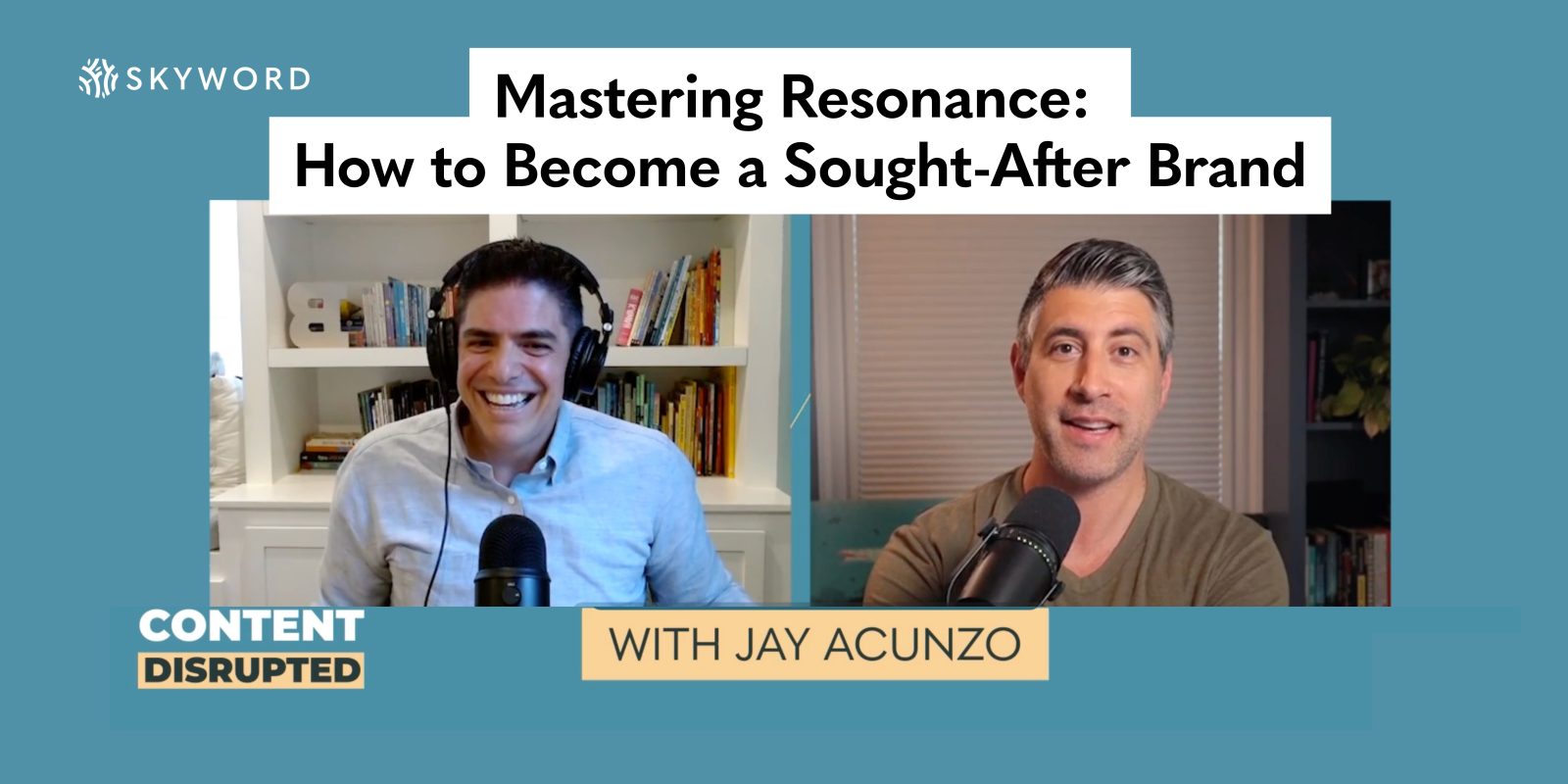
To make your content stand out instead of just producing more of it, shift your focus from reach to resonance. Messaging consultant Jay Acunzo argues that no amount of content volume will generate trust if it reads like everything else in your category. The fix: build high-conviction positioning only your brand can own — using frameworks like the X/Y Premise Test and a 4-part pitch structure (Align, Agitate, Assert, Invite) — so your audience remembers you, seeks you out, and acts.
Creating more content won’t help your business if it doesn’t resonate with your target audience.
In this episode of Content Disrupted, public speaking and messaging consultant Jay Acunzo joins Dan Baptiste to unpack a major challenge in the AI-powered marketing world: How to go from fighting the losing battle for search clicks to being a business that’s highly sought for its distinctive expertise and perspective.
Jay reveals why the “reach for reach’s sake” approach doesn’t work: No amount of exposure will make your audience care.
The real solution? Focus on resonance.
He dives into the dangers of mistaking awareness for affinity, how generic expertise has become a commodity, and how to deliver high-conviction messaging that only your brand can own.
He doesn’t just critique the content hamster wheel; he offers practical advice on how to drive resonance:
- How marketing teams can think like creators
- How content IP helps win business
- His X/Y Premise framework for crafting distinctive positioning
- The inside-out mindset that prevents positioning like a commodity
- The 4-part structure of a powerful pitch
Listen to this episode on the go! Anywhere you listen to your favorite podcasts.
Why Content Volume Became a Trap
Jay explains how the industry’s obsession with content quantity created a cycle of mediocrity where we confuse production with progress and feed platforms instead of building trust.
Acunzo points to his own background as a cautionary example. As a former journalist with a steady habit of side projects, he used volume as a way to practice — never to drive results. Quantity sharpened his skills; quality was always the aim. Today, that order has flipped. Marketing teams treat production itself as the goal, churning out mediocrity at breathtaking scale to feed platforms that, as Acunzo puts it, “don’t care about our businesses. They care about their own business.” Social networks are advertising networks dressed up as communities, and the brands feeding them are generating free ad inventory while convincing themselves it’s strategy.
Why Resonance Matters More Than Reach
Jay breaks down the fundamental problem with traffic-focused marketing: awareness is a proxy when what we’re after is affinity, and only resonance creates action, trust, and results.
Resonance, as Acunzo defines it, is what happens when your message doesn’t just reach an audience — it moves them. Awareness gets you seen. Resonance gets you chosen.
Acunzo defines resonance as “the urge to act people feel when a message or a moment with you aligns so deeply with them that they feel amplified.” It’s almost physical — like reaching through the screen and tapping someone on the chest. He points to the keynote speaker who ends with a whisper and gets a standing ovation: that’s not volume, that’s impact. Reach is how many see it. Resonance is how much they care. And no amount of reach guarantees they care — which is why marketers obsessed with traffic so often watch their dashboards inflate while pipeline stays flat.
The 4-Part Pitch Framework: Align, Agitate, Assert, Invite
Jay introduces his structure for effectively sharing ideas — Align, Agitate, Assert, Invite — and explains how it transforms how we successfully engage others with our perspective.
- Align: Start with a belief your audience already holds.
- Agitate: Surface the tension or problem they feel but can’t name.
- Assert: Introduce your distinctive point of view.
- Invite: Give them a clear next step to engage with that idea.
Acunzo illustrates the framework using the marketing conversation itself. Align: you have a goal — pipeline, growth, trust with your audience. Agitate: but the current playbook isn’t working. You’re driving traffic that isn’t converting, repurposing content into a million small pieces, and looking for new budget to fund more of what’s already broken. The marketers you reach are signaling the work isn’t landing — so why is the instinct to put it in front of even more people? Assert: the diagnosable problem isn’t reach. It’s that your expertise has been commodified. You’re sharing basic advice anyone can find anywhere. Invite: stop scaling what barely works. Start building a premise only you can own. The structure works because it earns agreement before introducing a new idea — and “we have problems with the current approach” is a sentence most marketers are too afraid to say out loud.
Why Memorability Is the Real Competitive Advantage
Jay argues that being seen isn’t the challenge; being remembered is. He shares why memorability, not frequency, should guide how we communicate.
Acunzo draws a sharp line between the two strategies. Most competitors are agonizing over how to get in front of an audience ten times in a week. The better question, he argues, is: what can you say to your audience today that they will think about ten times that day? Both approaches produce repeat exposure. Only one is defensible. He compares it to a memorable meal — the cauliflower dish you can’t stop thinking about, that you end up recommending to friends and bringing up unprompted. “We’re really obsessed with visibility. We’re really bad at memorability.” Visibility takes brute force and budget. Memorability takes a point of view potent enough that your audience carries it for you.
Why Brands Must Engage Buyers Earlier in the Journey
Jay uses a racing metaphor to explain why brands must engage buyers earlier in the journey, not just try to convert them at the last mile. Most enterprise marketing budgets are concentrated at the bottom of the funnel — the “finish line” — where buyers have already made up their minds. The real opportunity is to shape preference upstream, before a shortlist exists.
Picture your buyer running a road race, Acunzo says. Most marketing waits at the finish line: a marketer leaps out from a bush, waving, shouting, “pick me!” Then a second competitor parachutes down at the last mile, also waving. A third whips off a blanket from a stroller — turns out, not a baby, just another competitor shouting “pick me!” Meanwhile, the smartest communicators have figured out something simpler: they joined the runner earlier and ran the whole race alongside them. By the time the finish line appears, the buyer turns to the shouting competitors and says, “Thanks, but I already have a running buddy.” Last-mile marketers try to influence how people buy. The brands that actually win shape how people think — long before a purchase decision is on the table.
How to Turn Ideas into Defensible Brand IP
Jay explains how to build a premise-driven platform that transforms your expertise into defensible IP — framing, naming, and storytelling that people remember. Generic expertise has become a commodity. The differentiator is proprietary framing: when you name a concept, you own the conversation around it.
Acunzo points to business strategist Michelle Warner as a model. On paper, Warner could be slotted onto a spreadsheet alongside every other small-business consultant — a race that ends in competing on price or fame. Instead, she built a premise: sequence over strategy. Knowing the next right move matters more than knowing all the moves. That single reframe became defensible IP. It named her podcast. It shaped her newsletter. It informed every guest appearance and every framework she built. She isn’t just teaching business strategy — she’s evangelizing a perspective competitors can’t copy without sounding like her. Acunzo calls this the difference between sharing expertise and packaging it: “Suck out all the goodness from a big-concept business book, all you’re left with is the IP.” The premise is the heads-up display. The frameworks, signature stories, and proprietary terminology are the rest of the suit.
The X/Y Premise Test for Content Differentiation
Jay shares a simple formula to sharpen your message:
“This is a [podcast/blog/brand] about X. Unlike others about X, only we Y.”
If you can’t finish that sentence, you’re not differentiated. The X/Y Premise Test forces you to articulate what makes your perspective irreplaceable — not just different, but exclusively yours.
Why Big Brands Settle for Comfortable Average
Jay explains why most big logos stop trying to differentiate and how small, clear voices can win by being bold and memorable. Enterprise scale often rewards risk aversion — which means the safest content gets approved, and the most distinctive ideas die in review. The brands that break through are the ones willing to trade comfortable average for high-conviction messaging.
Acunzo doesn’t soften his read on enterprise behavior: “The larger a brand gets, the more they just pay lip service to wanting to differentiate. What they really want is to be comfortably average. Average products for average people, mass products for mass audiences.” He points to category-leading software brands that all converge on the same posture — “the system of record,” “the only objective right choice” — as if buyers actually make decisions that way. They don’t. People choose subjectively, based on who they trust and whose ideas they remember. The fix, borrowed from his mentor Andrew Davis: stop claiming to be the solution. Be a solution — one built on an idea your audience hasn’t considered before. “Don’t be the best,” Acunzo says. “Whatever the hell that means. Be their favorite.”
Final Thoughts: Compete on the Impact of Your Ideas
Jay urges marketers to stop scaling what barely works and start building conviction-driven communication that moves people.
Key Takeaways
- Resonance beats reach: No amount of content volume creates trust or action. Focus on messaging that moves your specific audience, not exposure metrics that inflate dashboards without generating pipeline.
- Use the X/Y Premise Test to audit differentiation: Complete the sentence “This is a [format] about X. Unlike others about X, only we Y.” If you cannot finish it, your content is interchangeable with competitors’.
- Structure every pitch around Align, Agitate, Assert, Invite: This 4-part framework ensures your messaging starts from shared belief, surfaces real tension, introduces a distinctive claim, and ends with a clear call to engagement.
- Memorability is the real advantage — not frequency: Being seen repeatedly matters less than being remembered. High-conviction, premise-driven content creates recall; high-volume, low-distinctiveness content creates noise.
- Generic expertise is now a commodity: In an AI-powered content landscape, any brand can produce competent content on any topic. What AI cannot replicate is a proprietary point of view — defensible IP built through named frameworks, original language, and specific experience.
- Engage buyers before the last mile: Most enterprise budgets concentrate at the bottom of the funnel. The brands that shape preference upstream — before the shortlist forms — win the decision before the RFP drops.
Frequently Asked Questions
What is the difference between resonance and reach in content marketing?
Reach measures how many people see your content. Resonance measures how deeply it lands — whether it creates trust, recall, and action. According to Jay Acunzo, awareness is a proxy metric; what enterprise marketers actually need is affinity, and only resonance generates it. You can reach a million people and move none of them. Resonance is the mechanism that turns attention into business outcomes.
What is Jay Acunzo’s X/Y Premise Test?
The X/Y Premise Test is a positioning diagnostic: “This is a [brand/show/blog] about X. Unlike others about X, only we Y.” If you can’t complete the Y with something specific and defensible, your content is undifferentiated. The test forces brands to articulate what makes their perspective irreplaceable, not just topically relevant.
What is the Align, Agitate, Assert, Invite pitch framework?
It is a 4-part structure for sharing ideas with impact. You begin by aligning with a belief your audience already holds, then agitate by surfacing the tension or problem they feel, assert your distinctive perspective, and invite them to take a next step. The framework works for keynote talks, sales conversations, and content alike because it builds agreement before introducing a new idea.
How can enterprise brands stop producing commodity content?
Acunzo argues that enterprise brands default to “comfortable average” because organizational risk aversion rewards safe, undifferentiated content. To break the pattern, marketing leaders should invest in proprietary framing — naming your concepts, owning original language, and building premise-driven content platforms that competitors cannot replicate. The goal is defensible intellectual property, not just another asset in the content library.
Explore past episodes of Content Disrupted and insights from enterprise marketing leaders on Apple Podcasts, Spotify, or YouTube.
Resources: